Saturday, May 7, 2011

An Echo from Bigelow Mountain


Here we have a letter from a former BPL employee, written in February, 2010. Dan spent most of his adult life protecting and preserving that which makes Maine so wonderful and unique.
***************************

In June of 1976, the voters of Maine made the extremely wise decision to protect and preserve the natural treasure that is the Bigelow Mountain Range located in both Franklin and Somerset Counties. At that time, this incredible area was threatened by a development plan that would have transformed it into an "Aspen of the East" type of ski resort.

What, thereafter, became the Bigelow Preserve, owned by the people of the State of Maine, is now, in my opinion, once again in great jeopardy. Today that threat exists in the form of the proposed construction of a massive forty-eight turbine wind project that would be located just a few miles from the southeast corner of the Bigelow Preserve, on the very front doorstep of the east end of Little Bigelow Mountain.

Wind turbine structures that rise over four hundred feet above the mountain and ridge tops of Highland Plantation would be starkly visible from one of the most spectacular stretches of the Appalachian Trail. This section of trail runs along mountain tops, east to west, from Little Bigelow, Avery Peak, West Peak, the Horns to Cranberry Peak.

Thirty-five years ago this spring, Mainers exhibited the incredible foresight in realizing the value and wisdom in protecting this unique and dramatic mountain range for future generations, and acted upon that realization to create the Bigelow Preserve. It is a gem not only of great significance to the State of Maine, but of national significance, as well, being a highly valued segment of the Appalachian National Scenic Trail, better known to us as simply the Appalachian Trail, part of our National Park System.

My concern is not about debating the pros and cons of wind energy, and its future in Maine - - that can be done another day. Right now, the issue is about opposing one wind project that has been proposed for a site where it should not be placed.

If you wish to learn about efforts being made to protect and preserve the Highland Mountains, please go to: www.highlandmts.org.
Daniel Bell
*************************
Top Illustration compliments of Windtoons
Bottom Photo taken by Franklin Savage, Highland Plantation

Voices on the Value of Real Estate


Below is a presentation I made to the residents of Dixfield, Maine in August, 2010. Residents in the River Valley are facing the same predicament we in rural Somerset County are: The mountains surrounding their valley have been targeted by wind developers, and approximately 100 turbines are slated for those ridges.

A topic which is rarely mentioned, but which is of tantamount importance, is the effect which industrial wind facilities will have on our property values. For many of us, our homes are our major investment. Those investments must be protected from for-profit corporations which give claims of property value loss little credence. And the reason they do that, I believe, is because they know the truth. And the truth, if told, would reduce the likelihood that townspeople would be willing to approve their developments.
****************************

Good evening. My name is Karen Bessey Pease, and I am a resident of Lexington Township, where I live on a 70 acre homestead with my husband and children. I am a native of Maine. I am a newspaper columnist, an author, a humorist and the owner of a small business in Kingfield. I’ve been a real estate broker for twenty-two years, and I have owned Narrow Gauge Realty for the past nine.

I’m going to speak for a few moments about industrial wind and its potential impact on real estate values. While I am not an economist, I am an experienced real estate agent who listens to her customers and clients and who pays attention to and is directly impacted by the market.

Because Industrial Wind is a fairly new phenomenon in Maine, real estate agents and appraisers do not have access to the standard resources which we use when we address the topic of value. Usually, we can look at things called ‘comps’… comparable sales. When asked for an opinion of value on a property, we research recent sales of similar properties, adjusting for their slight differences in acreage, location, amenities, etc. Based on that information, we make a reasonable determination of a property’s current market value. Here in Maine, we do not currently have a database of homes sold in the vicinity of industrial wind developments from which to obtain comparable sales data.

In the absence of such a resource here in Maine, I’ve had to look further afield. I’ve had to trust in the research of real estate experts in other parts of the country, and on anecdotal reports from actual homeowners who have been impacted by wind turbines.

Certified appraiser Michael McCann has written a comprehensive report on this very topic and I am going to share with you some of the excerpts of testimony which he gave to the Adams County, Illinois Board in reference to the impact of industrial scale wind energy development on residential property. Mr. McCann is a well-qualified individual, and the report is thorough and detailed. His testimony provides a detailed explanation of the impacts he has found and his recommendations to avoid harm to adjacent property when siting wind projects. For any of you who are interested in reading the full report, please see me after this forum, and I will be happy to provide it for you.

Mr. McCann not only addressed the financial impacts of industrial wind on residential properties, he investigated and reported on the effects wind developments had on one’s use and enjoyment of their real estate. For many of us here, our homes represent our biggest investment of not only our money--but our time, labor and even, our love. This article gives insight into each of these areas.

Here are some of the findings and recommendations listed in the report’s summary. In the interests of time, and because I know you are going to ask questions about industrial wind on the mountains of Maine, I will keep these short and to the point.

McCann found that:
1. Residential property values are adversely and measurably impacted by close proximity to industrial wind turbine projects, with value losses measured up to 2-miles from the nearest turbine(s), in some instances.

2. Impacts are most pronounced within the "footprint" of such projects, and many ground-zero homes have been completely unmarketable, thus depriving many homeowners of reasonable market-based liquidity or pre-existing home equity.

3. Noise and sleep disturbance issues are mostly affecting people within 2-miles of the nearest turbines and 1-mile distances are commonplace…

4. Real estate sales data typically reveals a range of 25% to 40% of value loss, with some instances of total loss as measured by abandonment and demolition of homes, some bought out by wind energy developers and others exhibiting nearly complete loss of marketability.

5. Serious impact to the "use & enjoyment" of many homes is an on-going occurrence, and many people are on record as confirming they have rented other dwellings… for use on nights when noise levels are increased well above ambient background noise and render their existing homes untenable.

6. Reports often cited by industry in support of claims that there is no property value, noise or health impacts are often mischaracterized, misquoted and/or are unreliable. The two most recent reports touted by wind developers and completed in December 2009 contain executive summaries that are so thoroughly cross-contingent that they are better described as "disclaimers" of the studies rather than solid, scientifically supported conclusions. Both reports ignore or fail to study very relevant and observable issues and trends.

7. If (governing boards) approve a setback of 1,000 feet, 1,500 feet, or any distance less than 2- miles, these types of property use and property value impacts are likely to occur to the detriment of… residences and citizens for which the nearest turbines are proposed to be located.

8. The approval of wind energy projects within close proximity to occupied homes is tantamount to an inverse condemnation, or regulatory taking of private property rights, as the noise and impacts are in some respects a physical invasion, an easement in gross over neighboring properties, and the direct impacts reduce property values and the rights of nearby neighbors.

9. In the county for which McCann completed the study, he estimated that a market value reduction of $6.5 million was projected for the residential property located in the footprint and within 2-miles of the pending project.

Recommendations

Mr. McCann gave recommendations for a governing board which was considering allowing a permit for an industrial wind development. Since I know many of you are from towns where just such a thing is occurring, I’ll quickly go over the high points.

1. A Property Value Guarantee should be required of the developer. A fund or “developer bond” should be required to guarantee no undue delay in payment(s) to legitimately affected homeowners, and/or to buy out homeowners located within 2-miles of any turbines if they elect to relocate away from the turbine project(s) and cannot sell for the pre-project market value of their properties.

2. An alternative to the bonding element would be to require that the developer(s) obtain a specialized insurance policy from a high risk insurance carrier such as Lloyds of London. If Lloyds was unwilling to provide such insurance, however, that should be compelling to the (governing board) that professional risk-management actuaries find such projects too risky for even them to insure. Under those possible circumstances the burden of risk is fairly placed with the developer, rather than the residential occupants who are being surrounded or otherwise directly impacted by close proximity of the projects.

4. If (a governing body) decides to permit projects, they should require developer funding and a plan to constantly monitor not only sound levels in decibels, but also in low frequency noise emissions from the turbines utilizing the best available technology, or at least homeowner reports and logs. There is significant evidence and personal accounts confirming that low frequency sound/noise is “felt” by nearby occupants, and… cannot be measured by decibels as audible noise is typically measured.

Disclosure of the owner’s actual experience to prospective buyers is necessary from both an ethical perspective and potentially under the Real Property Disclosure Acts, as a “known” defect or detrimental condition. Thus, documentation should be created at the cost of the developer(s), to insure that appropriate disclosures can be made to any prospective buyer(s) of homes within the 2-mile zone.

As an aside, this—in and of itself, will directly and immediately impact sellers of property within 2 miles of an industrial wind development, and—in my opinion, create a liability for sellers and real estate brokers if such defects are not made known.

5. McCann states that appropriate (sound) devices should be installed at the developers expense at all occupied dwellings and property lines within a 2-mile distance of any turbines, and the (governing body) should retain the ability to immediately enforce the shut-down of any turbines exceeding a level of 10 decibels or more above ambient background noise levels. The proximity of constant or frequent noise sources is an adverse impact to the use and enjoyment of a residential property, and indicates a basis for loss of property value.

6. An alternative would be to place a limit on hours of operation, requiring turbines within 2 miles of any occupied dwelling be shut off during normal sleeping hours.

7. If the (governing body) finds that the wind energy projects are desirable… property owners should be afforded the opportunity to sell to either the developer or the (governing body) (at current [pre-wind] value).

8. A bonding requirement or escrow for decommissioning and reclamation of wind turbine pad sites (should be) a condition. To demonstrate solvency companies should pay the bond requirements before starting construction. (This is something Maine does not currently require. In some cases the developer may request to wait until year 11 to begin paying into its decommissioning fund.) It’s basically insurance in case the company goes bankrupt or otherwise abandons the wind project without taking down the turbines and reclaiming the land.

9. (There should be ) an aesthetic landscaping requirement for wind project developers to plant mature trees or groves to shield the view between residential properties and turbines.

10. McCann further states that (Governing bodies) should consider a moratorium on wind energy project development(s) until such time as:

* A thorough and complete Wind Energy Ordinance is developed and adopted…which incorporates all the protection and authority of zoning, building and health codes.

* Appropriate Conditional or Special Use standards are developed and adopted, to insure wind developers carry the burden of their for-profit projects rather than the hosting jurisdiction(s) and/or neighboring property owners.

* The actual experiences of numerous existing turbine neighbors is documented thoroughly by an impartial group of professionals with appropriate qualifications in the various relevant fields of expertise, i.e., acoustic engineers, medical sciences, valuation professionals, etc.

********************************

These are paraphrases from an incredibly well-written and comprehensive report by an experienced real estate professional, and we here in Maine are lucky to have access to it. Adams County was proactive. They requested this study BEFORE allowing industrial scale wind developers their permits to build. The state of Maine has not provided a similar resource for its citizens, so I hope you will make good use of this study until such a time as our government does the same.

It is important that we also hear from those who are experiencing industrial wind first-hand. Here are a few words from a young man who is building a home on Vinalhaven Island, and whose people have lived on the Maine coast for 12 generations:

“I have succeeded this year in erecting a comfortably small structure. The design is passive solar. The load bearing structure is a timber-frame, hand carved by myself and a good friend, made of island spruce. … My goal, beyond providing for myself a comfortable and affordable home, was to model for people an alternative to the traditional, chemically and energy intensive, way that most modern homes are built.”

“And then this fall the Fox Island Wind turbines began to turn…. Since they've begun turning I have experienced sounds/feelings that are unlike anything I could have previously imagined and ones that I find extremely disturbing. The intensity of the effect varies according to turbine rpm speed... The faster the rpm's the more pronounced the effect. The effect is that of a steady rhythmic low pulse. It is perceived by my ear as a whoosh followed by a whump that I feel in my sternum and head. I am finding the experience overwhelming and am sincerely concerned for my health and well-being. This is not just a sound that a person should "get used to".

"I have.. discovered that there is no spot on my property that I can go to take a break from the stress created by the sonic bombardment I receive during their operation. I am fortunate that my father has a home in town that I can retreat to for the night. My neighbors who live within a close proximity of the turbines are not so fortunate and have had to endure night time noise levels and rhythmic sonic pulsations that have made it difficult for them to rest.

"Three nights back I stayed the night in my home for the first time. I could not sleep and spent the night in restless repose. The rhythmic pulsing from the turbines was overwhelming and I found it impossible to ignore. After two nights in my home spent without any good rest I retreated to my father’s place. I am greatly concerned that this home that I've worked so hard to build will be unlivable and that all of my work will be for not. All of my wealth is invested in my land.”
*************************

Wind developers come into our towns promising economic boom due to job creation, an increase in valuation due to the infrastructure they build, and a host of other advantages to locals termed ‘tangible benefits’. What they don’t mention are the effects their developments have on our properties and their individual valuations. They don’t talk about how state and county subsidies decrease once that tax base increases. They say nothing about the high cost of loss of ‘quality of place’. They don’t promise to immediately set aside money to decommission the turbines, and they don’t promise to compensate us if our investments depreciate due to their for-profit developments.

Many will argue that a land owner has rights, and that other citizens can’t protest over what use their real estate is put. As a real estate professional and an owner of real property, I am very much in favor of land-owner rights. But we have zoning ordinances all across this country. We have them because sound, and sight, and smell and contamination do not recognize property borders. What we do quite often adversely affects our neighbors, and we do not have the right to do that. When I purchased my home in 1994, there were pages and pages of restrictions on what I could and couldn’t do. I couldn’t build higher than a certain number of feet. I couldn’t put a septic or a new structure near a brook or a seasonal run-off or an intermittent stream. I even had to have the driveway culvert inspected before installing it. I joked with the LURC employee at one point.

“Can I paint my roof hot pink?” I asked.

“No”, was the response.

Due to the aesthetic quality which needed to be maintained in Maine’s wild places, hot pink would not be acceptable. Seeing something like that which would not fit harmoniously into the environment would impact my neighbor, I was told.

We all have to live together. We all need to look out for our neighbors. And we all deserve the ability to enjoy our homes and benefit from the equity we’ve earned without fear of loss. I urge you to take advantage of the growing amount of information available on the subject of land-based industrial wind. I have access to articles and studies on this subject, and if you would like to see me after the forum, I’ll take your contact information and make that available to you. Become knowledgeable… for with knowledge, comes power. The power to make decisions for yourself, for your neighbors, and for Maine--this beautiful state which we call ‘home’.

Thank you.
********************************
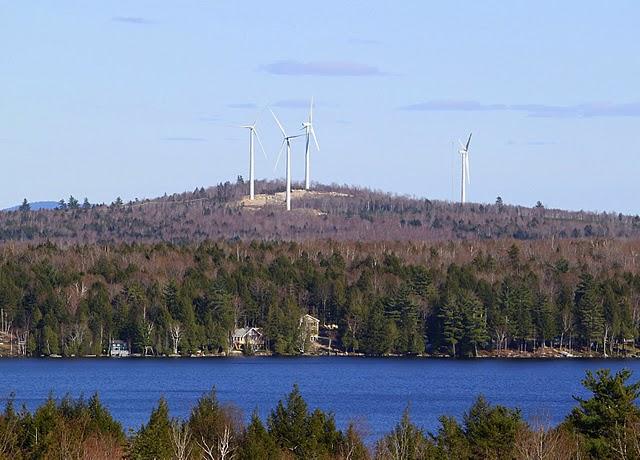
Top Photo: The village of Burlington, Maine, under the turbines of Rocky Dundee, a First Wind project
Second: From Upper Cold Stream Pond--Rocky Dundee turbines above lakefront cottages
Next: A home in Mars Hill surrounded by First Wind's industrial wind turbines
Then: Caribou Pond un the shadow of First Wind's Rollins project
Finally: One of the Beaver Ridge, Freedom turbines (Patriot Renewables) dwarfing a farm

Friday, May 6, 2011

Strong Voices Fall on Deaf Ears


There are many, many personal dramas in the battle to restore Mainers' 'quality of life' after a wind facility has been improperly sited. In the previous posting, I shared a letter written by Cheryl Lindgren of Vinalhaven Island. Since that pervasive noise first infiltrated their lives, the Lindgrens and their neighbors have spent countless dollars and hours trying to get the Department of Environmental Protection to enforce already inadequate sound standards so that they can live without the damaging effects of wind turbine sounds. Below is a press release regarding their attempts to regain the peace and enjoyment of their homes. And this link, regarding Art Lindgren, Cheryl's husband, tells a poignant story. A story which may be repeated over and over again--but with different casts of characters and different outcomes--if we do not succeed in forcing wind developers to properly site their developments and comply with noise standards. Please take a moment to visit this link. It's important.

Thank you.
*********************

FOX ISLANDS WIND NEIGHBORS PRESS RELEASE
State of Maine to Wind Turbine Farm on Vinalhaven: Turn Down the Noise
Neighbors of Wind Turbine Farm Stand Their Ground

November 29, 2010
Contact: Cheryl Lindgren, 207-867-4773

(For Immediate Release)

Last week, the State of Maine affirmed that the Vinalhaven
wind turbine farm violates state standards for noise. Neighbors afflicted by the turbine noise are hoping it is a turning point in the year-long dispute between the operation of three 1.5 megawatt GE turbines.

Since the commissioning of the wind turbine project a year ago, the local utility—Fox
Islands Electric Coop and Fox Islands Wind—had denied noise violations. During this
time, neighbors endured excessive noise on a regular and frequent basis. In its finding, the Maine Department of Environmental Protection calls this a “very serious matter”.

The agency undertook a rigorous analysis to determine its position, based on a July 18th complaint filed by the neighbors. Fox Islands Wind has until December 3rd to outline exactly what its intentions for addressing the problems. Within 60 days, the utility is required to implement a noise mitigation plan. On Nov. 6th, the neighbors filed a second official complaint and have more than a dozen additional complaints cued up for submittal.

From its commissioning in November 2009, neighbors were shocked by high noise levels
produced by the turbines. Their efforts to validate noise complaints and the ensuing
disagreement with the wind turbine operator has attracted national attention including front page stories in the Boston Globe, the New York Times, and AP.

The Vinalhaven neighbors set out to make sure that the utility conformed to state law. This required a significant effort and investment in understanding acoustics and
measurement metrics and technologies. The efforts of the neighbors prompted the DEP to reexamine the adequacy of wind turbine compliance procedures. There had been no
regulatory mechanism to detect and validate noise complaints from wind turbines. If the Vinalhaven neighbors had not undertaken their own costly efforts, the local operator—Fox Islands Wind, LLC-- could have continued to operate in violation of their license conditions.

After filing numerous complaints between April and June 2010, the state, the neighbors and the local utility finally established a formal protocol requiring acoustical proof of violation. On July 18, 2010, the neighbors met the newly established requirements with a single complaint that was representative of excessive noise that could be measured on a regular basis.

Island Voices


What follows is a November, 2009 letter sent from Cheryl Lindgren of Vinalhaven Island, off the coast of Maine, to Dr. Monique Aniel, co-chair of the Citizens' Task Force on Wind Power. I share this letter with the author's permission. Fox Island Wind built a 3-turbine wind facility with the Islanders' support. But those living closest to the development were not apprised of the intrusive and damaging effects of living in the shadow of industrial wind. More about the ongoing saga on Vinalhaven in the days to come....
*****************************
Monique,

As to my "reflections on the sound"....

We had been told that there would be little or no noise from the turbines, particularly at our location of approx. 2400 ft. As each turbine was put into operation mode the noise increased. I was a bit surprise(d), almost speechless as I tried to grasp what the reailty of the situation was. It was soon apparent that there was a pervasive jet noise. Indeed I still look to the sky to see which direction the jet is going. It never passes. It took a day to be able to articulate what I was actually experiencing because my normal experience would say you hear sound. But my senses were telling me much more. I was hearing the whoosh of the blades, the jet of the nacelle's but there was something else. I was feeling the thrump of the turbines in my chest. A physical sensation that is impossible to escape. I can only say that I feel the sound. To a person who hasn't experienced the sound I usually get a funny look. Anyone within the turbines area knows exactly what I am speaking of. After a day and night of this I can also say that the thrumping can begin to make me feel ever so slightly off balance, in a mild way. I can't figure out if it's lack of sleep, emotional stress or the sounds. Probably all three. After nine years of sleeping with my window open to the quiet of an island night (which can include fog horns, buoy bells, and a babbling brook) I now close my window to try and block the turbine sound, but to no avail. It permeates. I awake in the middle of the night to a heaviness in my chest and my jaw clenched as I try to overcome the creep of the, for lack of a better phrase, the compression of the turbines.

Daily life has changed dramatically. Some days the wind will carry the jet sound to my neighbors instead of me...those days I try to garden outside. "Bad" days are spent inside and I am learning to have music on all the time....it sometimes helps but if there is a moment of silence the thrumping leaks through. The other night was one of the first sparkling clear dark winter nights....stars blazing in a jet black sky. I used to take walks in the darkness, the entire outdoors my cathedral. Now I hide inside. But you really can't hide. When the turbines are at full speed it's a constant, constant sound. Tears come easily these days.

The"'sound" has also affected our flock of ducks who just won't eat on days when the turbines are at 20RPM. When the turbines are off, or slowed down considerably they will eat. And there was one evening when we found an eider duck sitting on our back porch, as surprised as we were to find him there. I have heard that animals will flee the area around the wind farms. I think they have more sense than we do.

I hope this is of some help. Thanks for all your efforts.

Cheryl Lindgren

A Word on Wind with the Department of Inland Fisheries and Wildlife


What follows are two letters I wrote to the former Commissioner of Maine's Department of Inland Fisheries and Wildlife, back in the early days of my involvement in the Wind Energy Plan for Maine. To my relief, the MDIFW has recently stepped up to the plate and written an Agency Comment to LURC about the detrimental impacts the Highland Wind project will have on this area's native animals. I don't know if a change in the Administration in Augusta had anything to do with that, but whatever the reason; many Mainers are breathing a sigh of relief and feeling a ray of hope.
********************************
December 20, 2009

Maine Dept. of IF&W
41 State House Station
Augusta, ME 04333-0041

Dear Commissioner Martin,

I am writing to you from my home on the side of Hutchins Hill in Lexington Township, Somerset County. I am a Maine native, and have been a resident of this area since 1967, when my father was transferred here from Down East in Washington County. For fifteen years, these forests and mountains were a part of his district. He was a Maine State Game Warden, and retired in 1982 after twenty years of service.

The reason for this letter is to request your assistance. As I’m sure you are aware, there is a large-scale push to build industrial wind turbine developments along the ridges of our unspoiled mountains. There are many, many reasons why this plan is a colossal mistake. It is economically unfeasible, and there are huge health concerns and indisputable ‘quality of life issues’. As well, there will be irreversible environmental impacts—none of which will be positive influences on our ecosystems. I could expound on any of these issues, but I will concern myself with the topic which directly concerns you and your office; the wild animals of Maine.

Commissioner, I am not an expert on wildlife. I am not a biologist, nor a veterinarian. What I am is a woman who has spent her life in the company of animals, both wild and domestic. Before I could tie my shoes I’d bottle-fed a fawn. Before I could ride my bicycle, I was caring for raccoon kits. I have hand-fed fledgling hawks and owls. Accompanied Dad as he relocated beavers. Trapped coons in neighbors’ gardens to bring home and release in my own. I am a small scale farmer, too; as were my parents. I have raised horses, goats, steers, chickens, turkeys and pigs. For forty-four of my forty-six years, I have had dogs and cats in my home.

I know animals.

There is a remarkable dearth of information on the effects of these industrial turbines on our native fauna. Since I discovered Independence Wind’s intention to erect forty-nine 400’-500’ foot tall turbines along eight miles of forested mountaintops in Highland Plantation, I have been trying to discover evidence of exhaustive studies showing what effects these massive machines will have on the wildlife of our state–studies that should have been completed prior to the passage of LD#2283, the expedited permitting law which removes many of the standard restrictions for development of Maine’s rural and unorganized territories. It has become clear to me that these analyses have not been done.

As a woman with instincts of her own, I am appalled that no one seems to be asking the questions that immediately came to my mind. What will happen to our animals? How will the constant noise and change in the atmosphere around these sites affect an animal’s mating habits and its ability to carry its young to term? What will the vibrations sent throughout the bedrock of the mountains do to a hibernating animal’s instinctual need to den up during our harsh winters? What effect will the blasting of mountaintops and the building and maintaining of roads through untouched woodland have on the circuitous hunting and foraging trails of that forest’s wildlife? Wild animals are even more sensitive to changes in their environment than we are. Their senses are heightened. If human beings are getting sickened by the noise, and by the pulsing and thrumming air, and by the disorienting shadow flicker, then what effects will such elemental changes have on our native wildlife? Do we have the facts? We have one. And that fact is: We don’t know!

I am frustrated. It appears that the departments that are charged with protecting our natural resources have not been actively involved in any type of concerted effort to ascertain the ramifications of such massive encroachments into the wilds of Maine. I understand fully that there are powers which have sway over this issue and how our government agencies deal with it. But they shouldn’t have that power or influence. We are all charged with protecting those plants and animals which cannot speak for themselves. And we citizens expect that those in positions of authority will not let ‘big money’ or an administration run amok keep them from their appointed tasks.

Therefore, I am asking that you get involved. That you take a stand. That you vociferously lend your voice to both the wildlife of this state, and to the citizens who are tired of having others run rough-shod over us. Maine’s natural resources are what make this state unique. If we lose those, we’ve lost everything that is special; everything that really matters.

Please use your position to push for a moratorium on any permits issued under LD #2283 until we are sure, beyond a doubt, that these industrial developments will not have a detrimental effect on the wild and native creatures of Maine. Please use your own influence to push for studies (real, unbiased studies, and not those conducted by entities on the payroll of wind developers) to determine what consequences the turbines, and the massive infrastructure involved in their placement, will have on the animals of our forests. Please stand up for those creatures which depend on you and your department for their health and welfare.

I look forward to hearing from you, and if there is any way I can assist you, please don’t hesitate to ask. I have a voice, and a vote, and a willingness to stand up for what’s right. The resident animals of this great state deserve our consideration. It’s time we stopped ignoring their right to live unmolested in this home that was theirs long before we humans moved in.

Thank you for your attention to this matter.

Sincerely,

Karen L. Pease
**********************
And, my second letter to Commissioner Martin:
**********************
January 18, 2010

Roland Martin, Commissioner
ME Dept. of IF&W
284 State St.
Augusta, ME 04333-0041

Dear Commissioner Martin,

I am in receipt of your January 11th response to my letter expressing my concerns about industrial wind development on the mountain ridges of Maine. Thank you for taking the time to reply.

In all honesty, I am disappointed by your response. I am going to be frank, and I hope that you will appreciate my candor and accept it for what it is; an honest woman with some intelligence who hopes to be spoken to in a straightforward and truthful manner.

You indicate that it is accepted as a ‘given’ that Maine’s mountaintops will be sacrificed to benefit developers of industrial wind complexes. You consider it a ‘done deal’. Our federal and state administrations decided that they were going to fast-track ‘big wind’, and I imagine they charged the departments under their authority to stay out of the way and not create any waves. Not any real waves… just a token few to placate a public that might have some serious concerns about these encroachments and their impact on this land and its inhabitants. At the state level, LD#2283 was designed in part by developers and endorsed by the Governor’s Task Force on Wind, and the people’s own representatives voted unanimously for that ‘emergency’ bill without debate—some without ever having read it. LURC’s normal discretionary powers were, for the most part, removed so that these developments could be permitted. Maine’s residents had their powers and their rights as citizens greatly curtailed so that we could not stand in the way of this industry.

However, LD#2283 and the issues surrounding its passage and implementation are matters that are beyond your control, and are ones that our senators and representatives must answer to and rectify. Instead, I will once more implore you to put politics aside and make the wildlife of Maine your primary concern. I do not know what you have been charged with. I am not privy to the orders you receive from ‘above’. But, Commissioner Martin, you are in effect saying that industrial wind developers will be allowed to build myriad roads through the forests and along the hillsides of Maine. You concede they will blast the bedrock and level the summits to build their concrete pads. They will strip the vegetation from the peaks and the transmission corridors, and they will control that vegetation with herbicides. They will erect monstrous towers which create incessant noise and disorienting shadow flicker. And while you recognize that all these massive changes to the habitat of our native species are imminent, all you can promise is that you will ‘request’ that the developer ‘conduct investigative studies to assess potential risk’.

That is not acceptable on many levels. The Department of Inland Fisheries and Wildlife shouldn’t request, they should demand! And it should not be Independence Wind’s consultants who these conduct studies. There is a direct conflict of interest when a consultant is being paid by the very businessmen whose development he is investigating. The developer should pay for the assessments, yes. But that money should be placed in a trust account managed by a third party, and the scientists conducting the studies should not in any way ‘answer’ to the entity whose actions are being looked into.

I do not believe it is responsible or prudent to concern ourselves only with those species with ‘special conservation needs’. If we do not take care of all the species in this state, we will find the list of those with ‘special needs’ growing by leaps and bounds. Even if only one or two species are adversely affected, that may very well impact the entire food chain with a domino effect.

I gather from your response that you believe these developments are inevitable. Your policy seems to be that once one is in place, we will wait and see what consequences it has on the wildlife in its environs. And then, we will use the data gained at their expense to mitigate the damage caused by the next wind energy plant.

Please let me say again: This is not acceptable. It shouldn’t be, should it? We have always placed the needs of mankind over the needs of the other species on this planet. We shouldn’t be deciding what level of impact is ‘acceptable’. The animals have no need for electricity, and yet, we expect them to sacrifice for our needs. As well, Maine itself produces more power than we consume. Why should our mountains, forests and wildlife be sacrificed to provide for those in southern New England with greater electrical needs?

I am looking for people who are willing to stand up and do what’s right. I’m not looking for lip service or placation. It’s time we started acting like the stewards we are supposed to be. Please take a stand on this issue and do what your integrity tells you to do. I am willing to do what I can to assist you, but I need to know that for Maine’s Commissioner of Fish and Wildlife, the fish and wildlife come first. As the daughter of a Maine State Game Warden, that is what I was taught. I would hate to discover that it was all a farce.

Please feel free to call me at the above number, or email me for expediency’s sake. I look forward to working with you to protect our wildlife from the advent of intrusive wind turbines in their natural homes; our unspoiled regions of Maine.

Sincerely,

Karen L. Pease

P.S. If you have not had the opportunity to research and study all the facets of wind turbine developments, there is a plethora of information available. There are answers to many of the questions that the general public hasn’t even thought to ask. I hope you are concerned enough to search for the truth instead of buying the party line. A good place to begin is this website, www.highlandmts.org, and there are links there to help you expand your search. Thank you, sir, for your time.
***********************

Photo of Patty Porcupine (with cat "Stevie" in the rear)taken by Josie Pease on our porch, May 2010.
Photo of cow and calf moose taken by Karen Pease in Mayfield, June 2010
Photo of osprey and fledgling taken by Karen Pease in Abbott Village, July 2010
Photo of Canadian geese taken by Karen Pease in July, 2010

From my Backyard


Below is a letter written in March of 2010 and published by Maine Today Media.
*******************************
When I entered the campaign to save Maine’s iconic mountains from development, I had a huge dread; the fear of being seen as a ‘NIMBY’ (Not in my backyard). I didn’t want to be perceived as someone who was not interested in current events unless they directly affected me. I saw the acronym ‘NIMBY’ as a form of slur… and no one likes to be insulted.

Several months have passed since I entered the fray. My education has been equivalent to the school of hard knocks. Trial by wind, per se. I knew nothing about mounting a battle to change the policy of a government which I strongly disagreed with. I had no idea how to work to defeat a proposal designed by a wealthy industry and supported by people in positions of power. I’m still learning and every day I make a mistake. Most often, I learn from it.

As I researched the phenomenon of mountaintop industrial wind, I discovered many surprising facts. I began this process with an instinctual aversion to the plan to develop our wild peaks, but I was lacking a lot of the details about the proposal to place wind turbines along over 300 miles of pristine summits. I only knew that it couldn’t be a good thing; that the plan that was being thrust upon us did not seem to be a reasonable one. Now I know what many of those negative impacts will be. I’ve also come to the conclusion that a NIMBY is exactly what I want to be.

We human beings have a lot on our plates; families to raise, jobs to go to, homes to build and maintain. We have to pay for those homes, those kids, and for the vehicles to get us to those jobs which pay those bills. We have parents and siblings who need us. We have friends to lend a helping hand to, schools to support and a civic duty to our town. Life is busy--and often--life is a struggle.

We simply cannot devote ourselves to every battle that needs fighting. We do not have the capacity to throw ourselves into the mix every time a wrong needs righting. Instead, we depend on others with the same values and common sense to take up their swords and defend their own territories, families and ways of life. That’s what ‘home rule’ is. That’s one of the most fundamental precepts of America as a country. More elementally, it’s instinctual in almost all living creatures. We defend our turf, or die trying.

The animal kingdom is made up of communities. The primary and most significant of these is the family; parents and children first, extending outward to grandparents, siblings, cousins. Next in importance is our neighborhood, then the larger village which these neighborhoods combine to create; those people upon whom we depend, but to a lesser degree than we rely on our kin. When America was founded, our strength rested in the small communities scattered across this vast land. Men who provided for and took care of their families were called to action to defend from home the larger community; the colonies which would later become the U.S.A. Our Minutemen and militias defended their home turf successfully; defeating a larger, more organized and better funded campaign.

That is the heart of the matter. I care about what happens across the country and around the world. But I simply cannot make every battle a cause that I must wholeheartedly throw myself into. No-one would survive if we took on every single struggle that we believed in. We try to do our part when issues of importance are made known to us, but we have to keep something in reserve. We have to save ourselves for the conflicts that affect us directly, because we know that our distant neighbors will only be able to aid us on the periphery, just as we do when they need our support.

I no longer have an aversion to the title ‘NIMBY’. NIMBY is synonymous with home rule and home defense, and that is something in which to take the utmost pride. I am a NIMBY, and damned proud of it! If my family, friends and neighbors are successful in protecting our home front, then we will set the standard for other NIMBYs… our fellow countrymen who are doing the same. We will be helping other Americans who have the courage to stand up and say ‘Not in my backyard!’

**********************
Photos: Kaz in my backyard
My 'home front', a.k.a. 'the front of my home'. :o)

Thursday, May 5, 2011

Idaho Wind


As I've already mentioned, other states (as well as countries all around the globe) are fighting the same wind battles we are. Some folks are playing catch-up-- just getting their 'wind bearings' and others are strides ahead of where we are.

World-wide, there are hundreds and hundreds of citizens' groups waging war against the corporate wind lobby.

Below is an excerpt from a letter I received from a 'wind warrior' in Idaho. And above is an interesting ad from the same state...This is the wording, in case you can't make it out:

"Something is missing from the conversation about energy.

"For nearly a century, Idaho Power has been committed to clean energy. Today about half the energy in our portfolio is generated from hydro, wind, solar, biomass and geothermal. We are proud of our small carbon footprint and history of responsible energy that rivals any electric utility in the nation.

"What Happens When The Wind Doesn’t Blow?

"For the most part, people work by day and rest at night. Wind, however, sometimes does the opposite. Or it blows one minute and not the next, so integrating wind energy into the grid that brings power to our homes requires facilities that can quickly adjust to moment-to-moment fluctuations in wind activity. Unfortunately, traditional generating plants can take hours to come on-line and off, so they are not suited to the task. Integrating all of this variable capacity also undermines the time-tested, science- and technology-driven, 20-year look-forward plan that is required of all utilities. And that just isn’t right.

"Sensible. Dependable. Responsible. It’s the Right Thing.

"To learn more and make your voice heard, visit www.GetPluggedIn.com. Together, we can get wind back on a responsible track." (I haven't had time to check out that link...guess I'd better do that, huh?)

***********************************
From Idaho:

"Our moratorium bill did not move out of House Committee by 1 vote -- so disappointing. We tried to push a siting bill through during the last week of the legislative session, but it did not move out of Committee by 3 votes. However, we did have a win. In the final moments of the legislative session, Idaho's sales tax rebate for wind did not pass on the Senate for by 1 vote. That was it -- then the session was over! This was huge! I testified in the Senate Committee. When it moved out of committee, I actually left the capitol building because I could not bear to watch the Senate floor debate -- I thought it would pass for sure. I was at lunch having a quick bite to eat before I made the long trip home when our lobbyist called and said that it failed on the floor by 1 vote. I guess the Senator who was the Chairman of the committee where I testified (and 1 other person against it) was the only Senator that debated against the bill -- our lobbyist said his debate was heroic! Of course, I went back over to the capitol building after I got the news so that I could shake the lawmakers' hands. It was incredible. Our tiny group and 1 lobbyist beat their army of lobbyists (worth $1 million). It was a great day in Idaho!

"Is your legislative session still going? Did Maine propose a moratorium?"

*****************************

Maine's Legislature is still in session. And we DID write a moratorium bill, but today it was voted by the Energy, Utilities and Technology Committee as "Ought Not To Pass". However, the EUT Committee is holding another work session on Tuesday, and we have hopes that they will "tweak" LD 1366 (And Act to Update the Maine Wind Energy Act...), vote that it "Ought To Pass" and support the wishes and the will of the people of Maine rather than the corporate wind lobby. There are too many very real problems with industrial wind; from the sometimes-questionable conduct of developers and government officials, to the health effects of the turbines, and the impact to property values and the environment. And on and on and on. As frustrated as we become and as hopeless as we sometimes feel, there are many good men and women in Augusta who simply didn't know all the facts behind 'wind' when they passed LD 2283 in 2008.

Please help my contacting the members of the EUT Committee and ask that they support our legislation.