
Showing posts with label Industrial Wind Facility. Show all posts
Showing posts with label Industrial Wind Facility. Show all posts
Thursday, October 4, 2012

Sunday, December 18, 2011
Iberdrola's Many Costly Voices

Iberdrola Renewables–a subsidiary of Iberdrola Group and the owner of CMPC–is poised to become a major player in the industrial wind energy plan for Maine. But before Maine embraces this foreign company and the product it’s selling, there are some crucial questions which must be answered.
Wind energy is expensive in many ways—both to tax-payers and to rate-payers. Our neighbors in North Carolina are discovering the same thing.
This excerpt is from the December 15th edition of the Charlotte Observer:
“The developer of the largest wind farm ever proposed in North Carolina says the project has stalled because no utility wants to buy the power the project would produce.
“Iberdrola Renewables, having put more than three years into a 31-square-mile wind farm near the coast, this week began notifying property owners and public officials…that the project is on hold indefinitely. If built, the Desert Wind Energy Project… would have ranked among the largest wind farms in the country.
“… the Spanish company has been unable to find a buyer for the power output of Desert Wind.”

No purchaser for wind power? Is this due to the price wind will cost? Or are there other disadvantages to wind power which makes it undesirable?
In trying to protect its investments and promote its agenda, the wind lobby has been vociferous about the jobs “wind” is bringing to our state. Thus far, experienced local construction companies like Reed & Reed and Cianbro have been contracted to build the developers’ wind facilities. However, the November 28th issue of Renewable Energy Magazine reported that another Iberdrola subsidiary, Iberdrola Engineering and Construction, is moving into the wind facility construction business in the United States. Iberdrola has been awarded two construction contracts for wind developments in the region—in Groton, NH and Hoosac, MA. That begs the question: If Iberdrola is successful in getting permits for wind facilities in Maine will they import their own crews to build them?
Another lamentable detail: When CMP customers write checks for our monthly electric bills, we’re sending them to a processing center in New Jersey. We’re not mailing them to Augusta as we did for decades–back when CMPC was a Maine company, instead of a Spanish one. Why is it that Iberdrola out-sources this traditional source of employment for Mainers?

Add to that; the fact that CMP intends to lay off dozens of employees once it has completed installing smart meters across the state, and one has to ask:
Is this foreign company looking out for the best interests of Maine’s citizens?
Tuesday, December 13, 2011
Voices that Snap, Crackle and Pop
Maine is the most forested state of the contiguous forty-eight. And Maine has an aggressive wind energy plan. But what is the plan to protect our forests, homes, livelihoods and lives from turbine-originated fires? These mountaintop industrial facilities will present many serious problems for firefighters and the Maine Forest Service. I would like to see the strategy our state has in place for protecting Maine from this new hazard. |
| Add caption |
North American Clean Energy
By Scott Starr
According to reports, the cost of a fire that damages or destroys a wind turbine can be as much as $2 million. Property damage to the turbine, and nearby areas, from fires reported in the past decade ranged between $750,000 and $6 million.
Aside from the imminent hazards of a burning turbine, there is also the risk of sparks, embers, or debris falling to the ground and setting off a wildfire due to the remote location of many wind farms. Even if a turbine is not fully burned or damaged, or a potential fire doesn’t spread to the surrounding countryside, costs can be considerable. This was shown during a recent fire at a wind farm in California, which resulted in the loss of just one converter cabinet. Cost for replacement: $243,000, including parts and downtime.
Although the financial loss and costs of a fire might be the primary concern of any wind farm operator, pressures are building up from environmental groups and the concerned public in general. Turbine fires—and, particularly those that spread—should be a significant concern, affecting the planning stages of any project. To this avail, permitting might be more drawn-out, costly, and time-consuming process. Turbine manufacturers and wind farm operators are now, more than ever, becoming acutely aware of the costs, safety, and the environmental arguments in favor of effective fire detection and suppression. But what are the fire risks associated with wind turbines?
Technical equipment and combustible material are concentrated in the nacelle and, once a fire starts in a turbine, it can be fuelled by up to 200 gallons of hydraulic fluid and lubricants. The nacelle itself is constructed from highly flammable resin and glass fiber, and internal insulation can become contaminated by oil deposits, adding to the overall fuel load.

The most common cause of a turbine fire is a lightning strike—a risk that is heightened by the installation of taller and taller wind turbines. Turbines are now being built that are up to 320 feet high. They’re frequently sited in exposed and high-altitude locations. Globally, there are around 16 million lightning storms and approximately 1.4 billion lightning flashes every year. However, only 25% of these are cloud-to-ground (the remainder are either cloud-to-cloud or intra-cloud); yet, this still equates to the US being hit by between 15 million and 20 million ground strikes a year, according to the Colorado-based National Lightning Safety Institute.
The consequences can be judged from the following example. Recently, a wind turbine caught fire as a result of a lightning strike. Burning parts of the rotor blade, which had been struck, fell and caused a secondary fire in the nacelle—all at a cost of $200,000 and 150 days lost operation.
Mechanical failure or electrical malfunction can also trigger a fire as capacitors, transformers, generators, electrical controls, transmission equipment, and SCADA (Supervisory Control and Data Acquisition) systems all have the potential to catch fire. This risk is amplified when there are loose or broken electrical connections, or there is an overloading of electrical circuits. Braking systems pose a particularly high risk of fire. Overheating can cause hot fragments of the disc brake material to break off, rupturing hydraulic hoses, and resulting in the highly combustible hydraulic fluid being expelled under pressure and coming into contact with the hot disk brake fragments. Hydraulic pumps and connections can also fail, allowing the fluid to erupt into flames when it comes into contact with a hot surface.
A case in point was a fire where a slip-ring fan of a double-fed induction generator broke. Sparks were generated by the rotating fan impeller, which set the filter cabinet’s filter pad alight. The fire then spread to the hood installation, causing $800,000 worth of damage.
With the fire risk becoming greater as more turbines come into operation, the National Fire Protection Association (NFPA) has added wind turbine and outbuilding fire protection standards to NFPA 850 (“Recommended Practice for Fire Protection for Electric Generating Plants and High Voltage Direct Current Converter Stations;” 2010 Edition). This provides fire protection recommendations for the safety of construction and operating personnel, physical integrity of plant components, and the continuity of plant operations. The revised 2010 edition includes detailed recommendations relating to wind turbine generating facilities.
Wind farms are usually built in isolated locations with restricted access, placing them beyond the prospect of immediate attention by the fire service. Even when emergency services are able to respond quickly, few have the equipment capable of firefighting at the height of modern wind turbines. The solution is an effective fire detection and suppression system. Such a system should be intrinsically safe, not require any external power that can fail or put the system out of operation, and it needs to be able to stop a fire precisely where it breaks out before it can do irreparable damage to the turbine or spread elsewhere. It also needs to be purpose-designed to contend with the vibration, dust, debris, airflow through the nacelle, and the extreme temperature variations. An effective system also has to be capable of providing 24/7 unsupervised wind farm protection.

Wind farm fires do happen, and many in the industry suspect that they occur far more frequently than statistics suggest. This is because a significant number of turbine fires go unreported due to their remote location. Emergency services are not always involved and there are no regulatory requirements to report related fire incidents. Hardly surprising, many insurers are becoming increasingly concerned, and the opinion of many can been summed-up by the following statement: “Fire. It’s not a matter of if, it’s a matter of when.” Better safe than sorry.
Scott Starr is the director of marketing at Scottsdale, Arizona-based Firetrace International.
Wednesday, June 8, 2011
Stepping Up To The Plate...

Stepping up to the plate.
I was never much of a ball player. Oh, I could hit a pitch—but it was mostly in self-defense. I didn’t want that fast ball to hit me—so I knocked it out of the way with everything I had. I’ve always had a finely tuned self-preservation instinct. But--when it came to catching a line drive, or throwing with accuracy or strength, or running to beat hell--I was a dud.
Yes, I was one of the last kids picked when teams were chosen for baseball, and I was usually given the position of right or left field. That was okay. Baseball wasn’t one of my strengths, but I had others.
The one thing I learned early-on was that it took courage for me to pick up the bat and step up to the plate. I knew I was a poor player. I knew there was a good chance I’d let my team down, or embarrass myself—or both. But I wasn’t a quitter, and I had pride. If the job of playing baseball had to be done, I’d do it--whether I liked it, or not. Whether it caused a knot of dread in my stomach, or not. Whether I excelled in it, or not.
It’s what had to be done.
Right now, there’s something else which needs doing, and I’ve been amazed at how many Mainers have stepped up to the proverbial ‘plate’. Out of 20 pieces of legislation proposed by citizens in the hopes of bringing fairness and balance to the wind energy plan, and in an effort to protect Mainers’ health, quality of life, and property values--only one bill has survived.
LD1366.
Rep. Stacey Fitts, co-chair of the Energy, Utilities and Technology Committee, proposed an amendment to this bill, after promoting the demise of the others. In an attempt to appear as though our words weren’t “falling on deaf ears”—this amendment offers to move up—from 2013 to 2012—a previously mandated study of ‘wind’.
In essence, this is a “do nothing” bill.
Hearing and responding to the concerns of his constituents, as well as the constituents of many other Legislators, Rep. Larry Dunphy, of District 88, has submitted a “minority report” version of this bill. His version of LD 1366 would establish a set-back of 1.5 miles from the base of industrial turbines to residences. On-the-ground studies have shown that at distances of over 7,500 feet, the deleterious effects of industrial wind’s unique sounds and vibrations are diminished in areas which aren’t mountainous in terrain. This setback would protect hundreds—if not thousands—of Mainers from potential health effects and reductions in real estate property values. At the same time, Rep. Dunphy’s version of the bill would grant to Mainers something which the Wind Energy Act took away. Freedom of choice. If land-owners within that 1.5 mile setback wish to opt out and petition the siting authority for a variance, they can do exactly that.
It’s a win-win, right? Additionally, the need for sound studies would be removed. Rep. Dunphy’s version of this bill will save Maine tax-payers money.
Protect the health of Mainers. Give them freedom of choice. And save them money.
What’s not to love?
Please write to the members of Maine’s House and Senate, and ask them to pass the MINORITY REPORT version of LD 1366. I am pasting in their addresses below, to make the process a little simpler. All you need to do is write a simple note asking that they support the MINORITY REPORT VERSION OF LD 1366… a bill which is NOT anti-wind, but pro-Mainers. Copy and paste the addresses into the ‘bcc’ part of your email. And click SEND.
Your voices should be heard. Your votes and opinions matter. Please support Mainers’ rights and ask that our Legislators pass Rep. Dunphy’s minority report version of LD 1366.
Thanks. You will make a difference, if you take the time to ‘have a say’.
************************
Emails for the Maine House of Representatives and the Maine Senate (just copy and paste)
kent23@myfairpoint.net, RepJohn.Martin@legislature.maine.gov, RepBernard.Ayotte@legislature.maine.gov, pedgecom@maine.rr.com, mikeblackbear@gmail.com, tyleraclark@msn.com, alexander.willette@gmail.com, RepJoyce.Fitzpatrick@legislature.maine.gov, rdl_chief@yahoo.com, clarkhe@beeline-online.net, jeffery.gifford@gmail.com, duchesne@midmaine.com, jdill@umext.maine.edu, RepAdam.Goode@legislature.maine.gov, cdicemom@aol.com, RepSara.Stevens@legislature.maine.gov, jparker339@roadrunner.com, emily.cain@gmail.com, djhouse20@gmail.com, texn77@aol.com, repguerin@gmail.com, richardsond@hermon.net, fwintle@gmail.com, fredlaw@myfairpoint.net, RepDavis@midmaine.com, rumridge27@gmail.com, mcfaddenh@roadrunner.com, gjmaker@gmail.com, dburnsinv@midmaine.com, dtilton@maineline.net, info@crockerhouse.com, elsie.flemings@gmail.com, wkumiega36@gmail.com, chapmanHD37@gmail.com, andre@andrecushing.com, Kurlykim40@aol.com, jgillway@yahoo.com, riouxrep@aol.com, erinherbig@gmail.com, aobrien2008@gmail.com, ryan.harmon82@yahoo.com, joanwelsh08@gmail.com, EdMazurek1@aol.com, cbkruger@myfairpoint.net, wes893@aol.com, danadow2050@yahoo.com, Jon@JonMcKane.com, deb.sanderson@hotmail.com, RepLes.Fossel@legislature.maine.gov, morissette2010@gmail.com, cotta@fairpoint.net, annadblodgett@yahoo.com, maeghanformaine@gmail.com, kdfoster@roadrunner.com, lincoln67@myfairpoint.net, kerrilprescott@gmail.com, bmacdon@roadrunner.com, HL7mike@gwi.net, cpriest1@comcast.net, kimolsendistrict64@hotmail.com, pskentz5@hotmail.com, seth@sethberry.org, mike@mikeformaine.org, bolduc74@yahoo.com, bick0585@aol.com, lajoie1@midmaine.com, mikecarey123@gmail.com, rwagner@bates.edu, mrotundo@bates.edu, Woodysnavy@gmail.com, henry.beck@gmail.com, thomas.longstaff@gmail.com, RepRobert.Nutting@legislature.maine.gov, RepSharon.Treat@legislature.maine.gov, mln@fairpoint.net, LGary.Knight@usa.net, patricksaflood@roadrunner.com, keschl@yahoo.com, jjpicc@gmail.com, jeffmccabe4me@gmail.com, pdcurtis2@hotmail.com, pegilbert@hotmail.com, lanceharvell@hotmail.com, russellblack@juno.com, jarrodscrockett@gmail.com, petersonhouse08@gmail.com, sheryljbriggs@gmail.com, terry@megalink.net, twinsor@megalink.net, jtimberlake_us@yahoo.com, rankin8076@roadrunner.com, RepPaul.Waterhouse@legislature.maine.gov, rwsarty@fairpoint.net, rep.hamp@yahoo.com, RepRich.Cebra@legislature.maine.gov, utumike@aol.com, mmcclell@maine.rr.com, dalecrafts@aol.com, RepEllie.Espling@legislature.maine.gov, dcwebster@comcast.net, melissawalshinnes@gmail.com, meredith@burgessadv.com, apg1@maine.rr.com, RepMarkBryant@yahoo.com, geplummer@aol.com, mpn3@maine.rr.com, pstuckey114@yahoo.com, steve.lovejoy@myfairpoint.net, deniseharlow@hotmail.com, annehask@maine.rr.com, votechipman@gmail.com, RepDiane.Russell@legislature.maine.gov, dillesquire@aol.com, tmorrison16@msn.com, eberleja@earthlink.net, kaenrath@gmail.com, annpeoples116@msn.com, tdrisco1@maine.rr.com, avolk@volkboxes.com, hsirocki@maine.rr.com, knappjanes09@gmail.com, lindafsanborn@gmail.com, huntforlegislature@gmail.com, RepGeorge.Hogan@legislature.maine.gov, dpilon@maine.rr.com, lmvalentino54@yahoo.com, megan.rochelo@gmail.com, acasavant@maine.rr.com, dburnsy12@gmail.com, RepWayne.Parry@legislature.maine.gov, bennettco2000@hotmail.com, sixwings@metrocast.net, RepJohn.Tuttle@legislature.maine.gov, RepJoan.Nass@legislature.maine.gov, libertymom1@msn.com, markweves@yahoo.com, kathydhchase@hotmail.com, bmoulton@localnet.com, wcw63@aol.com, RepDevin.Beliveau@legislature.maine.gov, waymitch10@hotmail.com, Sipayik@midmaine.com, mthibmyrep@aol.com, SenPhilip.Bartlett@legislature.maine.gov, cwrector@hotmail.com, RepStacey.Fitts@legislature.maine.gov, rep.hamp@yahoo.com, dacray@msn.com, skime2@roadrunner.com, RepAaron.Libby@legislature.maine.gov,RepJon.Hinck@legislature.maine.gov,
acornell@alexcornell.org, rbbeavers@comcast.net, mndion@msn.com, RepLouis.Luchini@legislature.maine.gov,
SenDawn.Hill@legislature.maine.gov,
SenRonald.Collins@legislature.maine.gov,
SenJon.Courtney@legislature.maine.gov,
SenNancy.Sullivan@legislature.maine.gov,
SenBarry.Hobbins@legislature.maine.gov,
SenLawrence.Bliss@legislature.maine.gov,
SenJohn.Patrick@legislature.maine.gov,
SenJoe.Brannigan@legislature.maine.gov,
SenStan.Gerzofsky@legislature.maine.gov,
SenRichard.Woodbury@legislature.maine.gov,
SenBill.Diamond@legislature.maine.gov,
dhastings@hastings-law.com,
SenJohn.Patrick@legislature.maine.gov,
senlois@roadrunner.com,
SenMargaret.Craven@legislature.maine.gov,
SenGarrett.Mason@legislature.maine.gov,
SenThomas.Saviello@legislature.maine.gov,
seth@sethgoodall.com,
dptrahan@roadrunner.com,
demccormick@.tds.net,
SenRoger.Katz@legislature.maine.gov,
SenThomas.Martin@legislature.maine.gov,
rodwhittemore@gmail.com,
firewood@tds.net,
SenBrian.Langley@legislature.maine.gov,
Senator@KevinRaye.com,
schneidersenate@msn.com,
rrosen113@aol.com,
nichi@aol.com,
SenDebra.Plowman@legislature.maine.gov,
SenRoger.Sherman@legislature.maine.gov,
SenTroy.Jackson@legislature.maine.gov,
Sunday, June 5, 2011
The Voice of a King

Today is a special day for the citizens of Maine. Today, the Portland Press Herald printed TWO articles written by industrial wind developer and former governor, Angus King. My comments to the first op-ed, 'Energy Choices and the 'No Free Lunch' Principle' are below.
Mr. King says: "Critics of wind power fail to acknowledge that it calls for much smaller economic and ecological trade-offs than any other source."
Mr. King fails to mention: Wind delivers an unreliable, intermittent, unnecessary and expensive product which cannot be stored, and which has not been proven to provide the benefits he touts—that wind will reduce our dependence on those ‘foreign’ fossil fuels, or cause any appreciable reduction in greenhouse gasses. Trade-offs? We expect something of value for the price we'll have to pay.
Mr. King says:”And all the drama about wind power in Maine plays right into their hands”
What Mr. King doesn’t say: That ‘drama’ is called ‘freedom of speech’. That ‘drama’ is what happens when the people of Maine take the time to study the facts about ‘wind’ and realize that the current wind energy plan is a poor one which is the product of influence by a powerful corporate lobby, and not the product of sound science and economics. And as far as playing ‘right into their hands’… Mr. King’s modus operandi is this: more scare tactics, and more attempts to make those who are opposing his get-rich-quick schemes appear as if we are the problem. I suppose we’ve become a problem for Mr. King. He was relying on encountering complacent minions who would accept his every assurance about the benefits of wind without ever asking a single question or demanding proof of the value of his product. Now… when he says ‘their hands’… is he speaking of hands in the Middle East? If so, I think the people of Maine would like to hear Mr. King say that he has never had dealings with Iberdrola Renewables. That he has no intention of selling his developments to them, or partnering with them at some point in the future. Because Iberdrola Renewables is—kind of—“they”, are they not? A Spanish company partnered with the United Arab Emirates and Qatar? If Mr. King has no intention of ever selling Maine wind to a foreign company such as Iberdrola Renewables, then I think Mainers would be relieved to hear him state exactly that.
Mr. King says: “Wind opponents don't seem to realize that if they want to say no to wind, that's OK, but when they do, they are actually saying yes to something else, and that something else will most likely have much greater economic or environmental impacts.”
What Mr. King should not say: Mr. King should not put words in other people’s mouths. And Mr. King should not make vague statements such as this one. Mainers require proof. HIS product—wind--has so few benefits that it is astounding to realize that the wind energy plan has progressed as far as it has without any type of accountability or proof that the energy produced is reliable, affordable, and worth the incredible costs to our pocketbooks, our environment, our health, our Quality of Place, or our energy security. Until such scientific and economic proof is provided, no further wind developments should be built. That is not saying ‘no’. That’s saying, ‘Wait. We can’t afford to proceed with such an enormous plan without having proof that the benefits are worth the costs.’ That is the prudent, common-sense thing to do. Maine already produces more electricity that we consume, so there is no emergency. Let’s make sure this is the right thing to do. Show us the proof.
Mr. King says: “Almost 80 percent of all the energy used in Maine (for electricity, heating and transportation) comes from oil.”
Mr. King has a way with words. He is a master at obfuscation. How much of that 80% is used for electricity generation, Mr. King? Two percent or less? That statement is like saying “Almost 80 percent of all potatoes used in Maine (for potato guns, mashing, and baking) come from Aroostook County.” Sheesh.
Mr. King says: “we'll be that big national park many of the wind opponents seem to want.”
Mr. King is doing it again. Trying to create divisiveness, and putting words in others’ mouths. I oppose the current wind energy plan, but I am not in favor of a ‘big national park’. Wind opponents are perfectly capable of speaking for themselves—a fact which Mr. King is well aware of. If we weren’t capable of doing exactly that, there would be no need for the two op-eds Mr. King had published in today’s PPH.
Mr. King says: "There ain't no such thing as a free lunch"

Quaint colloquialism aside, what Mr. King fails to mention is that—in the case of industrial wind—there most certainly is. Free lunch for developers; but very costly to tax-payers. Mr. King says nothing about the 1603 cash grant, a no-strings-attached gift from the federal government for ‘renewable’ projects such as those he hopes to build in Roxbury and Highland. Up to 30% of his projects’ costs could be reimbursed to Independence Wind, the company owned by Mr. King and Rob Gardiner. On a $200MILLION project, that’s a $60MILLION lunch. A bit more caviar for Mr. King than PB&J, I think.
Mr. King says: “Opponents of wind energy often repeat the silly charge that wind power somehow "destroys" mountains. They should go to West Virginia and see what the real thing looks like -- mountains torn right down to the ground to get at the coal.”
We should go to West Virginia, hmmm? With the high taxes Mainers pay, not many of us can afford the luxuries our former governor is accustomed to, such as traveling across the country in a motor home. Mr. King is very skilled at twisting others’ words and sensationalizing them. Coal in West Virginia and wind in Maine have very little to do with each other. Is Mr. King asserting that by building hundreds of miles of sprawling wind developments across our mountains, we will have an impact on coal mining in West Virginia? Prove it, please. With one exception, we do not use coal for electricity production in Maine. Nevertheless, that’s not even the point. Mr. King is again trying to turn the public’s eye away from the many problems inherent in his product of choice and make the issue about something else. He's also attempting to pit Mainer against Mainer, and Mainer against citizens of other states. He is demeaning in his attitude towards those of us who are opposing industrial wind projects based on the facts we discovered when we researched this issue. We all know the damage caused by coal mining. Does that mean Mr. King automatically gets a free ride, because his Highland project called for a mere 1.5 MILLION cubic yards of ledge and earth to be blasted and excavated? To give a visual, that amounts to more than 90,000 dump-truck loads full of mountain granite and soil. And that is based on fact, not speculation—taken from Mr. King’s most recent permit application submitted to LURC.
Mr. King says: Hydro “carries its own set of environmental challenges… New hydro, by the way, is about the same cost structure as wind -- expensive to build but essentially free to operate.”
Mr. King neglected to say that hydro has something of incredible value. It has the ability to be stored. Wind doesn’t. Mr. King also didn’t mention the flood control dams already in place in Maine rivers which could be retrofitted with turbines without new damage being done to the surrounding ecologies. Perhaps hydro would be a wiser investment for Mainers and for Mr. King?
Mr. King says: "Do I have to even discuss nuclear?"
Unless he’s an expert, Mr. King probably shouldn’t discuss nuclear energy. That’s not to say that the topic should be avoided altogether. All energy sources need to be debated, improved upon, and considered. Cost vs. benefit. We have amazing scientists who make advances all the time.
Mr. King says: “And don't forget the necessity of some really big transmission corridors through, you guessed it, Maine's western mountains.”
Let’s look at that statement, while ignoring the ‘you guessed it’ sarcasm. The Maine Legislature voted down a request from Quebec for that transmission corridor he speaks of, citing 'Quality of Place' and the damage to Maine’s scenic natural resources. And yet… the PUC approved the MPRP, a transmission corridor which will cut a 400+ mile long swath through 75 Maine towns. According to former governor John Baldacci, we needed this transmission upgrade to get wind energy to the states in southern New England, where it is needed. And Mr. King himself has applied for permission to build his own series of high-voltage transmission corridors through the Maine woods to get his product to market. Which will be less impactful to Maine’s natural resources? Dozens of transmission corridors criss-crossing the state, connecting 1800 turbines to the grid? Or one transmission corridor which would bring reliable and fairly inexpensive electricity into the state and country? It doesn’t seem reasonable for Mr. King to disparage one transmission corridor because it’s not going to benefit him, but promote those which will.
Mr. King says: “The whole energy world is falling down around our ears, and we're arguing about the occasional view? Give me a break.”
There he goes again. Scare tactics, sarcasm, and putting words in others’ mouths. Who’s arguing with Mr. King? We are opposing, yes. The burden of proof is his. Prove, with a science- and economic-based cost vs. benefit analysis that wind is ‘worth it’, and perhaps the conversation will change. And by the way… we’re not talking about ‘the occasional view’, are we? We’re talking about hundreds of miles of Maine’s mountaintops-- our most prominent feature—being capped by wind towers which are twice as high as Maine’s tallest sky-scraper. We’re talking about those same natural resources Mr. King urged Maine to protect in his 1995 inauguration speech. The Maine Center for Economic Policy agreed—they had this to say: “In recent years, numerous economic strategy reports have urged policy makers to capitalize on Maine’s unique and outstanding quality of place assets as effectively conveyed by the Brookings Institution’s influential report, Charting Maine’s Future: An Action Plan for Promoting Sustainable Prosperity and Quality Places.” The fact is that our storied natural resources and “Quality of Place” are a $10BILLION economic driver. If wind turbine developments were an ‘occasional view’, especially in the urban areas of southern Maine, our nature-based tourist industry wouldn’t be at risk. But 40 story turbines along 300-400 miles of rural summits won’t equate to ‘occasional’. Each development will be seen for miles and miles. Mr. King does his readers a disservice by not stating facts.
Mr. King says: “wind brings with it the first major investment in Maine in the past 15 years.”
Investment: The use of money in the hope of making more money.
Tax-payers and rate-payers in Maine and across the country are investing their money through grants, subsidies, TIF’s, accelerated depreciation, renewable energy credits, tax productions credits, and on and on.
Developers like Mr. King will profit by securing amazing returns on our money.
You’re welcome, Mr. King.
Mr. King says: “that saying no to wind is saying yes to something else -- at the moment, mostly oil -- whether we want to admit it or not”
Again… our former governor-turned-industrial wind developer is taking the liberty of speaking for others. And again; Mr. King needs to PROVE IT. Prove how saying ‘yes’ to Maine’s wind energy plan will say ‘no’ to oil. Facts, sir. Hard data. No computer modeling, no assumptions… prove it!If Mr. King can do that, he won’t have to write anymore sarcastic op-eds in which he takes the liberty of twisting words, he belittles and derides Maine citizens who disagree with what he is doing, he assumes to know his opponents minds, and which avoid the real issues by going off on tangents. Give us proof, please, that the 'presumptions of benefits' on which the Wind Energy Act rests are real. Prove it!
Saturday, May 7, 2011
Voices on the Value of Real Estate

Below is a presentation I made to the residents of Dixfield, Maine in August, 2010. Residents in the River Valley are facing the same predicament we in rural Somerset County are: The mountains surrounding their valley have been targeted by wind developers, and approximately 100 turbines are slated for those ridges.
A topic which is rarely mentioned, but which is of tantamount importance, is the effect which industrial wind facilities will have on our property values. For many of us, our homes are our major investment. Those investments must be protected from for-profit corporations which give claims of property value loss little credence. And the reason they do that, I believe, is because they know the truth. And the truth, if told, would reduce the likelihood that townspeople would be willing to approve their developments.
****************************
Good evening. My name is Karen Bessey Pease, and I am a resident of Lexington Township, where I live on a 70 acre homestead with my husband and children. I am a native of Maine. I am a newspaper columnist, an author, a humorist and the owner of a small business in Kingfield. I’ve been a real estate broker for twenty-two years, and I have owned Narrow Gauge Realty for the past nine.
I’m going to speak for a few moments about industrial wind and its potential impact on real estate values. While I am not an economist, I am an experienced real estate agent who listens to her customers and clients and who pays attention to and is directly impacted by the market.
Because Industrial Wind is a fairly new phenomenon in Maine, real estate agents and appraisers do not have access to the standard resources which we use when we address the topic of value. Usually, we can look at things called ‘comps’… comparable sales. When asked for an opinion of value on a property, we research recent sales of similar properties, adjusting for their slight differences in acreage, location, amenities, etc. Based on that information, we make a reasonable determination of a property’s current market value. Here in Maine, we do not currently have a database of homes sold in the vicinity of industrial wind developments from which to obtain comparable sales data.
In the absence of such a resource here in Maine, I’ve had to look further afield. I’ve had to trust in the research of real estate experts in other parts of the country, and on anecdotal reports from actual homeowners who have been impacted by wind turbines.
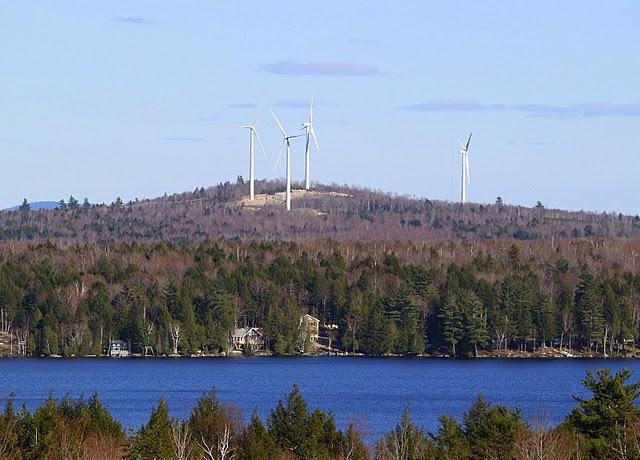
Certified appraiser Michael McCann has written a comprehensive report on this very topic and I am going to share with you some of the excerpts of testimony which he gave to the Adams County, Illinois Board in reference to the impact of industrial scale wind energy development on residential property. Mr. McCann is a well-qualified individual, and the report is thorough and detailed. His testimony provides a detailed explanation of the impacts he has found and his recommendations to avoid harm to adjacent property when siting wind projects. For any of you who are interested in reading the full report, please see me after this forum, and I will be happy to provide it for you.
Mr. McCann not only addressed the financial impacts of industrial wind on residential properties, he investigated and reported on the effects wind developments had on one’s use and enjoyment of their real estate. For many of us here, our homes represent our biggest investment of not only our money--but our time, labor and even, our love. This article gives insight into each of these areas.
Here are some of the findings and recommendations listed in the report’s summary. In the interests of time, and because I know you are going to ask questions about industrial wind on the mountains of Maine, I will keep these short and to the point.

McCann found that:
1. Residential property values are adversely and measurably impacted by close proximity to industrial wind turbine projects, with value losses measured up to 2-miles from the nearest turbine(s), in some instances.
2. Impacts are most pronounced within the "footprint" of such projects, and many ground-zero homes have been completely unmarketable, thus depriving many homeowners of reasonable market-based liquidity or pre-existing home equity.
3. Noise and sleep disturbance issues are mostly affecting people within 2-miles of the nearest turbines and 1-mile distances are commonplace…
4. Real estate sales data typically reveals a range of 25% to 40% of value loss, with some instances of total loss as measured by abandonment and demolition of homes, some bought out by wind energy developers and others exhibiting nearly complete loss of marketability.
5. Serious impact to the "use & enjoyment" of many homes is an on-going occurrence, and many people are on record as confirming they have rented other dwellings… for use on nights when noise levels are increased well above ambient background noise and render their existing homes untenable.
6. Reports often cited by industry in support of claims that there is no property value, noise or health impacts are often mischaracterized, misquoted and/or are unreliable. The two most recent reports touted by wind developers and completed in December 2009 contain executive summaries that are so thoroughly cross-contingent that they are better described as "disclaimers" of the studies rather than solid, scientifically supported conclusions. Both reports ignore or fail to study very relevant and observable issues and trends.
7. If (governing boards) approve a setback of 1,000 feet, 1,500 feet, or any distance less than 2- miles, these types of property use and property value impacts are likely to occur to the detriment of… residences and citizens for which the nearest turbines are proposed to be located.
8. The approval of wind energy projects within close proximity to occupied homes is tantamount to an inverse condemnation, or regulatory taking of private property rights, as the noise and impacts are in some respects a physical invasion, an easement in gross over neighboring properties, and the direct impacts reduce property values and the rights of nearby neighbors.
9. In the county for which McCann completed the study, he estimated that a market value reduction of $6.5 million was projected for the residential property located in the footprint and within 2-miles of the pending project.

Recommendations
Mr. McCann gave recommendations for a governing board which was considering allowing a permit for an industrial wind development. Since I know many of you are from towns where just such a thing is occurring, I’ll quickly go over the high points.
1. A Property Value Guarantee should be required of the developer. A fund or “developer bond” should be required to guarantee no undue delay in payment(s) to legitimately affected homeowners, and/or to buy out homeowners located within 2-miles of any turbines if they elect to relocate away from the turbine project(s) and cannot sell for the pre-project market value of their properties.
2. An alternative to the bonding element would be to require that the developer(s) obtain a specialized insurance policy from a high risk insurance carrier such as Lloyds of London. If Lloyds was unwilling to provide such insurance, however, that should be compelling to the (governing board) that professional risk-management actuaries find such projects too risky for even them to insure. Under those possible circumstances the burden of risk is fairly placed with the developer, rather than the residential occupants who are being surrounded or otherwise directly impacted by close proximity of the projects.
4. If (a governing body) decides to permit projects, they should require developer funding and a plan to constantly monitor not only sound levels in decibels, but also in low frequency noise emissions from the turbines utilizing the best available technology, or at least homeowner reports and logs. There is significant evidence and personal accounts confirming that low frequency sound/noise is “felt” by nearby occupants, and… cannot be measured by decibels as audible noise is typically measured.
Disclosure of the owner’s actual experience to prospective buyers is necessary from both an ethical perspective and potentially under the Real Property Disclosure Acts, as a “known” defect or detrimental condition. Thus, documentation should be created at the cost of the developer(s), to insure that appropriate disclosures can be made to any prospective buyer(s) of homes within the 2-mile zone.
As an aside, this—in and of itself, will directly and immediately impact sellers of property within 2 miles of an industrial wind development, and—in my opinion, create a liability for sellers and real estate brokers if such defects are not made known.
5. McCann states that appropriate (sound) devices should be installed at the developers expense at all occupied dwellings and property lines within a 2-mile distance of any turbines, and the (governing body) should retain the ability to immediately enforce the shut-down of any turbines exceeding a level of 10 decibels or more above ambient background noise levels. The proximity of constant or frequent noise sources is an adverse impact to the use and enjoyment of a residential property, and indicates a basis for loss of property value.
6. An alternative would be to place a limit on hours of operation, requiring turbines within 2 miles of any occupied dwelling be shut off during normal sleeping hours.
7. If the (governing body) finds that the wind energy projects are desirable… property owners should be afforded the opportunity to sell to either the developer or the (governing body) (at current [pre-wind] value).
8. A bonding requirement or escrow for decommissioning and reclamation of wind turbine pad sites (should be) a condition. To demonstrate solvency companies should pay the bond requirements before starting construction. (This is something Maine does not currently require. In some cases the developer may request to wait until year 11 to begin paying into its decommissioning fund.) It’s basically insurance in case the company goes bankrupt or otherwise abandons the wind project without taking down the turbines and reclaiming the land.
9. (There should be ) an aesthetic landscaping requirement for wind project developers to plant mature trees or groves to shield the view between residential properties and turbines.
10. McCann further states that (Governing bodies) should consider a moratorium on wind energy project development(s) until such time as:
* A thorough and complete Wind Energy Ordinance is developed and adopted…which incorporates all the protection and authority of zoning, building and health codes.
* Appropriate Conditional or Special Use standards are developed and adopted, to insure wind developers carry the burden of their for-profit projects rather than the hosting jurisdiction(s) and/or neighboring property owners.
* The actual experiences of numerous existing turbine neighbors is documented thoroughly by an impartial group of professionals with appropriate qualifications in the various relevant fields of expertise, i.e., acoustic engineers, medical sciences, valuation professionals, etc.
********************************

These are paraphrases from an incredibly well-written and comprehensive report by an experienced real estate professional, and we here in Maine are lucky to have access to it. Adams County was proactive. They requested this study BEFORE allowing industrial scale wind developers their permits to build. The state of Maine has not provided a similar resource for its citizens, so I hope you will make good use of this study until such a time as our government does the same.
It is important that we also hear from those who are experiencing industrial wind first-hand. Here are a few words from a young man who is building a home on Vinalhaven Island, and whose people have lived on the Maine coast for 12 generations:
“I have succeeded this year in erecting a comfortably small structure. The design is passive solar. The load bearing structure is a timber-frame, hand carved by myself and a good friend, made of island spruce. … My goal, beyond providing for myself a comfortable and affordable home, was to model for people an alternative to the traditional, chemically and energy intensive, way that most modern homes are built.”
“And then this fall the Fox Island Wind turbines began to turn…. Since they've begun turning I have experienced sounds/feelings that are unlike anything I could have previously imagined and ones that I find extremely disturbing. The intensity of the effect varies according to turbine rpm speed... The faster the rpm's the more pronounced the effect. The effect is that of a steady rhythmic low pulse. It is perceived by my ear as a whoosh followed by a whump that I feel in my sternum and head. I am finding the experience overwhelming and am sincerely concerned for my health and well-being. This is not just a sound that a person should "get used to".
"I have.. discovered that there is no spot on my property that I can go to take a break from the stress created by the sonic bombardment I receive during their operation. I am fortunate that my father has a home in town that I can retreat to for the night. My neighbors who live within a close proximity of the turbines are not so fortunate and have had to endure night time noise levels and rhythmic sonic pulsations that have made it difficult for them to rest.
"Three nights back I stayed the night in my home for the first time. I could not sleep and spent the night in restless repose. The rhythmic pulsing from the turbines was overwhelming and I found it impossible to ignore. After two nights in my home spent without any good rest I retreated to my father’s place. I am greatly concerned that this home that I've worked so hard to build will be unlivable and that all of my work will be for not. All of my wealth is invested in my land.”
*************************
Wind developers come into our towns promising economic boom due to job creation, an increase in valuation due to the infrastructure they build, and a host of other advantages to locals termed ‘tangible benefits’. What they don’t mention are the effects their developments have on our properties and their individual valuations. They don’t talk about how state and county subsidies decrease once that tax base increases. They say nothing about the high cost of loss of ‘quality of place’. They don’t promise to immediately set aside money to decommission the turbines, and they don’t promise to compensate us if our investments depreciate due to their for-profit developments.
Many will argue that a land owner has rights, and that other citizens can’t protest over what use their real estate is put. As a real estate professional and an owner of real property, I am very much in favor of land-owner rights. But we have zoning ordinances all across this country. We have them because sound, and sight, and smell and contamination do not recognize property borders. What we do quite often adversely affects our neighbors, and we do not have the right to do that. When I purchased my home in 1994, there were pages and pages of restrictions on what I could and couldn’t do. I couldn’t build higher than a certain number of feet. I couldn’t put a septic or a new structure near a brook or a seasonal run-off or an intermittent stream. I even had to have the driveway culvert inspected before installing it. I joked with the LURC employee at one point.
“Can I paint my roof hot pink?” I asked.
“No”, was the response.
Due to the aesthetic quality which needed to be maintained in Maine’s wild places, hot pink would not be acceptable. Seeing something like that which would not fit harmoniously into the environment would impact my neighbor, I was told.
We all have to live together. We all need to look out for our neighbors. And we all deserve the ability to enjoy our homes and benefit from the equity we’ve earned without fear of loss. I urge you to take advantage of the growing amount of information available on the subject of land-based industrial wind. I have access to articles and studies on this subject, and if you would like to see me after the forum, I’ll take your contact information and make that available to you. Become knowledgeable… for with knowledge, comes power. The power to make decisions for yourself, for your neighbors, and for Maine--this beautiful state which we call ‘home’.
Thank you.
********************************
Top Photo: The village of Burlington, Maine, under the turbines of Rocky Dundee, a First Wind project
Second: From Upper Cold Stream Pond--Rocky Dundee turbines above lakefront cottages
Next: A home in Mars Hill surrounded by First Wind's industrial wind turbines
Then: Caribou Pond un the shadow of First Wind's Rollins project
Finally: One of the Beaver Ridge, Freedom turbines (Patriot Renewables) dwarfing a farm
Thursday, May 5, 2011
Clearing My Throat

Welcome to VOW-- Voices On the Wind.
I first became interested in the subject of mountaintop industrial wind in October of 2009, when Independence Wind, owned by former Maine governor Angus King and Rob Gardiner, former president of Maine Public Broadcasting, came to neighboring Highland Plantation with a proposal to build a large-scale industrial wind facility atop these pristine ridges.
I've learned alot between then and now, as is evidenced in some of the early letters, columns and blog postings I wrote about this development--and about Maine's wind energy plan, in general. A year and a half ago, I never dreamed that 'wind' had anything to do with corruption, or power, or lies. I once believed the sales pitch: that wind was 'green' and good, that it would 'get us off foreign oil', reduce carbon emissions, counter the effects of global warming, bring American soldiers home, and enhance national security. Yes, those are all claims which the wind industry has made-- although they don't do so much of that anymore. And that's because people who have taken the time to research this topic have discovered that those claims simply don't hold water.
We said 'Prove it!'
They can't.
So, now (at least, here in Maine) it's all about 'jobs'. The wind lobby uses our poor economy as their rallying cry.
'Look!' they say. 'We're the only game in town, right now! We've employed workers who wouldn't have had jobs, otherwise!'
Ah, but is it intelligent or fiscally responsible to subsidize temporary jobs with tax-payer money to build projects with very little value?
Nope.
On VOW, I will begin by posting some of the many letters and articles I've written over the last eighteen months. With permission from other 'wind warriors', I'll post some of theirs, too. If you are late in coming into this, I encourage you to study the issue of mountaintop industrial wind. Don't believe me. Don't believe what the wind developers and their supporters say. Believe in YOURSELF, and your ability to separate the wheat from the chaff.
The truth will blow you away.

For my first entry, I'll share a letter I wrote to Angus King in March of last year. He never responded, although I know he received it, because he told me so when I spoke with him at a LURC meeting in Bangor the following month. Writing this letter took me completely outside my 'comfort zone', as so many things have in the last year and a half. It's not always easy to stand up for what you believe in, but if everyday citizens like myself aren't willing to do that, then everyday citizens like myself can't complain when we see our rights taken away or our freedoms stomped on. I don't enjoy being involved in controversy. In fact, I hate it. Ironically, I've always been considered a 'peacemaker'.
But I am convinced this wind energy plan is a disaster-in-the-making, so a 'comfort zone' is a luxury I can't afford.
As Mainers join with other Americans--and citizens around the world--to shed some light on this high-impact, low-benefit energy plan, please feel free to be one of the Voices On the Wind. And I welcome dissenting opinions, too. This is America, and this is my blog. Both promote free speech. All I ask is that you be respectful, and try to back your words up with truth. Lies, distortions and rhetoric are partly responsible for the mess we're in. Let's work together to do things a bit differently, this time.
*****************************
March 5, 2010
Angus King
PO Box 457
Brunswick, ME 04011
Dear Mr. King,
I had the pleasure of meeting you at the LURC Commissioners’ Meeting in Bangor on Wednesday, March 3rd. If you’ll remember, I came over to you as you were sitting with Jody and introduced myself to you as your opponent in the Highland Wind LLC project. I’d like to take this opportunity to speak with you candidly, as I did on Wednesday. This letter is a personal one, and does not reflect any views of the Friends of the Highland Mountains. It is simply one woman speaking to one man.
Please allow me to give you a bit of background information about myself, so that you will see me clearly. I am a Maine native, and have never lived anywhere else. I was born in Aroostook County, the daughter of a Maine State Game Warden (retired) and a stay-at-home mother. In 1967, Dad was transferred to the Kingfield district, and I grew up in the shadow of Mt. Abram. As a child, I roamed the woods of Maine; hiking mountains such as Abraham, Sugarloaf and Borestone. I swam in Chesuncook, Caucomgomac, Seboomook, Tufts, Onawa and Greenwood. My family members were baptized in the Carrabassett River and in Wilson Stream. I hunted the western woods with Dad, and fished the rivers and glacial ponds of the north woods with Mum. I cared for orphaned creatures such as white-tail fawns, raccoons, owls and hawks. I was raised to love and care for this land and its inhabitants. As a mother for the past twenty-seven years, I’ve tried to instill that same caring and stewardship in my three children.
As I stated, I am opposed to the development of the five mountain ridges in Highland Plantation. Not only that, but I am against the industrialization of any and all of Maine’s mountain peaks. The reasons are many and multi-faceted. After months of research, after speaking with experts on wildlife, and with environmental engineers, soils scientists, sound engineers and actual Mainers living in the vicinity of industrial turbine developments, I have determined that Big Wind on the ridgelines of Maine’s peaks is a disaster in the making.
I am not opposed to harnessing the power of the wind. I am convinced that our carbon emissions are doing great harm to our environment. I believe that human beings have to take bold steps alleviate or even eradicate the crisis that is ‘global warming’. To many, the fact that I attest to those statements and yet, protest the Highland Wind LLC development makes me a NIMBY. Someone whose words are hollow when confronted with something that will inconvenience me, or affect the quality of my life. Because of sentiments such as those, the decision to openly oppose your project was a daunting one. However, I was raised to fight fairly and with integrity—but to FIGHT–when I strongly believe in something. I strongly believe these mountaintop wind turbine developments are a very poor idea for the state of Maine.
Mr. King, I could fill page upon page with the concerns that I have about these projects. They range from economic to environmental and from quality of life to quality of place. They have to do with wildlife habitat and soil erosion and water quality and quantity. Birds and bats, herbicides, wide swaths cut through pristine forests, the altering of ancient ridgelines which were shaped by Mother Nature–these are but a few of the concerns which I have. I am disturbed by the maladies associated with turbine noise and shadow flicker. I am irritated that these complexes are touted as ‘green’ when there is much to that equation that is contradictory to conventional thinking. And I am angered that my tax dollars and those of my fellow Americans–which we could well use here at home–will go to support the economies of foreign countries such as Denmark and China, where these turbines are manufactured. However, I know you’ve been reading the newspapers and online forums, so you already know what those arguments are.
In all honesty, there are many pointed questions to which you have not given forthright answers. You seem to mock or invalidate honest citizens’ very real complaints of health issues associated with wind turbines. You’ve told Highlanders that they will not hear the turbines, and yet, Rob Gardiner stated in a recorded meeting that the 500 KWHs of free electricity given to those townsfolk would be in mitigation for any sound those residents might hear. You’ve twisted phrases in order to skirt the statement made in your own application whereby 1.6 million cubic yards of earth and ledge will be dynamited or excavated, saying it will not be ‘removed’ from the mountains. In all honesty, money and/or ‘tangible’ benefits have changed hands or been promised to individuals and entities if they do not oppose these developments. Some see this practice as simply ‘doing business’. I’m not so sure that would pass the litmus test in my home or my establishment. My standard line when a child or an employee asks me if they ‘should’ do something is this: If you have to ask, the answer is ‘no’. Have you ever, just once, honestly asked yourself if these mountaintop turbine developments are the best plan for Maine?
I believe you do have a desire to contribute to a healthy environment. Your personal and political history supports my belief. But I contend that the driving force behind your efforts to erect these massive turbines in our unspoiled regions is money, pure and simple. There are billions of dollars in stimulus funds waiting to subsidize these projects, and that is an incentive that is hard to resist. But Mr. King, I ask you, please. Please reconsider your plans. We only get one shot to do this right. Forty-story turbines on the pristine peaks of Maine cannot be what is right for a state which is known world-wide for its unspoiled wilderness regions.
I am enclosing a copy of my novel, Grumble Bluff. It is a gift to you, and I hope you will find and take the opportunity to read it. It won’t take much of your valuable time, I promise; perhaps three hours, cover to cover. In Grumble Bluff, you will discover the Maine of my childhood and of my children’s childhoods. I hope my grandchildren can find that same peace and serenity which has always been an integral part of the Maine experience. Grumble Bluff is a tale in which Maine’s ‘quality of place’ is, in fact, a very tangible benefit.
Thank you for allowing me to say my piece.
For the Mountains,
Karen Bessey Pease

Subscribe to:
Posts (Atom)