Showing posts with label LURC. Show all posts

Saturday, April 7, 2012

Maine Voices DO Make a Difference

             First WIND’S BOWERS Mountain Wind Project to be Denied
Grass roots opposition defeats Maine’s largest wind energy developer


April 6, 2012
Lincoln, Maine

The Land Use Regulation Commission (LURC) voted today not to allow First Wind Holdings, LLC of Boston to withdraw its application for the Bowers Mountain Wind Project. The project would have erected 27 forty-three story tall turbines on prominent ridgelines in Carroll and Kossuth, adjacent to the headwaters of the Downeast Lakes.  This area has been a magnet for sporting tourism for more than a century. It is home to the Village of Grand Lake Stream, the state’s premier salmon hatchery, and is the birthplace of the square-end canoe known as a Grand Laker.  LURC also directed its staff to complete the permit denial document as had been decided at their October 2011 meeting. The final denial vote will take place at on May 4, 2012 at the Washington County Community College in Calais.


The Partnership for the Preservation of the Downeast Lakes Watershed (PPDLW) has led the broad-based opposition to the project.  The Maine Professional Guides Association, the Maine Sporting Camp Owners Association, and the Grand Lake Stream Guides Association also opposed this project.

“I could not be happier.” says PPDLW member Gary Campbell. “It’s been a long arduous battle, but the natural beauty of the Downeast Lakes Region is well worth fighting for. Today’s vote shows that Maine is not willing to sacrifice this magnificent natural resource for a few megawatts of expensive and intermittent wind energy.”

After a long and well documented process that included a site visit, lakes tour, three days of formal public hearings, and three deliberation sessions, a straw poll taken in October showed the Commissioners in unanimous agreement that the project would have an unreasonably adverse scenic impact on a number of significant paddling and fishing lakes, and consequently the numerous sporting camps, lodges, professional guides, and ancillary support businesses that are the lifeblood of the area. The Commission instructed LURC staff to prepare a denial document.

Facing an imminent denial, the applicant, through lead counsel Juliet Browne of Verrill Dana, filed a request several weeks later that they be allowed to withdraw the project application.  After much deliberation, the LURC board tabled the request to withdraw, but did agree to give the applicant some additional time to reconfigure the project.  Interveners in the case argued that the applicant was simply venue shopping. In the end, the LURC Commissioners awarded the applicant an additional 90 days to reconfigure the project in hope of mitigating the project’s scenic impact, while expressing serious reservations that it could be mitigated at all. The applicant assured the Commission that 90 days would be enough time and that they would bring back a formal outline of a reconfigured project by March 9th.

Twenty minutes prior to expiration of the deadline, the applicant submitted a letter stating that “[First Wind] is not able to present a particular reconfigured project to the Commission at this time.” The letter then repeated the earlier request that they be allowed to withdraw the Bowers application. At today’s meeting LURC voted to officially deny First Wind’s request to withdraw and directed its staff to resume preparation of the application denial document. The denial is now scheduled to become official by Commission vote on May 4, 2012. 

The Scenic Downeast Lakes Region encompasses more than two dozen lakes including Pleasant, Shaw, Scraggly, Junior, West Grand, Pocumcus, Bottle and Keg Lakes. The turbines of the proposed Bowers Mountain Wind Project would have been visible from 11 lakes that are officially recognized as Scenic Resources of Statewide Significance, two of which boast Maine’s highest designation as “Outstanding for Scenic Quality” (Pleasant Lake and West Grand Lake).

PPDLW’s President, Kevin Gurall explains, “The Scenic Downeast Lakes Region has a long, rich history of providing a wilderness experience to visitors and sportsmen from all over the world. Celebrities from Ted Williams and Jimmy Doolittle, to Presidents and foreign heads of state, as well as multiple generations of families have been coming here for well over 100 years to enjoy this network of clean, largely undeveloped lakes. The guiding tradition on this watershed can be traced back to the 1850’s. We have 2nd, 3rd, and even 4th generation professional guides who stitch together a living providing sportsmen with an outdoor experience that leaves them with memories for a lifetime. Never mind that this type of experience is becoming rare in Maine, there aren’t many places like this left in the entire continental U.S… and that’s why it’s so important that we protect it so future generations will have the opportunity to make their own memories of the wilderness character and scenic magnificence that is the Downeast Lakes Watershed.  He added, “Those memories need not be ruined by an industrialized landscape… there have to be better solutions to our energy issues than defacing our treasured lake shore landscapes and our mountains.  Tourism is our largest industry in Maine and employs more than 140,000 people. That’s much too important to risk for the mere trickle of high priced energy that’s generated by these wind projects. “

“Although PPDLW sounded the initial alarm, this was a grassroots effort by more than 300 citizens. People from the immediate area, from all corners of Maine and beyond worked together for nearly three years to defeat this project.  It’s a true David vs. Goliath story.  Fortunately, we had common sense, truth, and the state’s scenic impact regulations on our side.” 


#           #           #

Tuesday, November 8, 2011

Voicing My Vexation


Many of you have followed along or participated in the Bowers wind project proceedings.  For that, many other people owe you thanks.  I ask that you continue to stay involved, because the developer is employing new and more devious tactics in an attempt to have its way.

On October 19th, Maine's Land Use Regulation Commission took a 'straw vote' on First Wind's permit application for the Bowers Wind Project.

LURC Commissioners voted unanimously to instruct staff to draw up a decision document DENYING a permit for the project.

Today, First Wind's attorney Juliet Browne submitted a lamentful appeal to LURC, requesting permission to 'withdraw' their application.  Employing the same tactics used last year during Trans-Canada's Sisk wind project application process, Ms. Browne is making an end-run, attempting to circumvent established procedures with deceitful tactics.

The letter Ms. Browne sent to project manager Fred Todd will most likely be posted HERE in a day or two.  In the meantime, here is my response to First Wind's request:

**********************************

November 8, 2011

Fred Todd, Project Manager
Land Use Regulation Commission
Augusta, ME 04333

Dear Fred;

As a citizen of Maine, I am writing this letter in response to the request LURC has received from First Wind’s attorney, Juliet Browne, of Verrill Dana LLP.  In regards to FW’s (Champlain Wind LLC’s) permit application #DP4889 for the Bowers Wind Project, Ms. Browne “respectfully requests that (First Wind) be allowed to withdraw its application for the purpose of reconfiguring the project…”

The applicant also generously offers to “extend the deadline for the Commission to issue a final decision…through January, 2012…”

Confronted with an imminent “deny” decision, the applicant is playing fast and loose with the state’s resources and is gaming the system.  Juliet Browne was a member of former Governor Baldacci’s wind task force which designed LD 2283, the so-called “expedited wind permitting law”—aka the “Maine Wind Energy Act”.  Due to the passage of this law, citizens in 2/3 of the state of Maine have been disenfranchised.  Our communities were rezoned without our input, and our right to “have a say” was sharply curtailed.  In addition, citizens were suddenly required to abide by a law wherein a tight time-frame was mandated in which our regulatory agencies must make decision on wind development applications.  DEP and LURC must ‘expedite’ these applications, and deny or approve within 6 months if there is no public hearing; and within 9 months if a public hearing is granted.  You have no options, and the public has no option—we must abide by the law.  And yet, First Wind, a company from another state, is graciously granting a Maine state agency an extension of time?

The unmitigated gall!

I have never been in favor of LURC’s taking of a ‘straw vote’, as (in my opinion) it is an invitation for an unscrupulous developer to do exactly what First Wind is doing.  It gives them a ‘heads up’ that they are not going to receive their permit and opens up this new avenue in an already difficult and expensive process.  Ms. Browne’s tactics were somewhat successful when she pulled this same rigmarole for Trans-Canada in the Sisk application process in the summer of 2010.  After taking a straw vote wherein Commissioners voted to deny the project, LURC later proceeded to approve an altered application for Sisk.   Whether or not the process was properly administered is now under debate and LURC and Maine citizens are waiting for a Law Court verdict on the appeal of that decision.

While I am not a fan of the Wind Energy Act, I (and each Maine citizen) have been obliged to abide by it until such a time as it is repealed.  First Wind and every wind developer looking to build grid-scale wind energy plants in this state must do the same.  They cannot have it both ways.  They cannot expect to benefit from their own law when it suits them; but then bend those rules, or expect special dispensation when that same law works against them.

I urge you to deny Ms. Browne’s request to withdraw First Wind’s application.  Additionally, I urge you to send a strong message to the developer.  LURC is not theirs to manipulate, nor is the DEP.  And our laws must be obeyed, whether they work as the wind industry planned, or not.  If First Wind would like to lead the charge in repealing the Wind Energy Act, with its tight time constraints and less stringent standards for development, many Maine citizens will step forward to offer them their support.  Until that time, they’ll have to play by the rules they set in motion.

If First Wind is allowed to withdraw from this lengthy process at a point where it has almost reached its conclusion, you will do a huge disservice to the people of Maine.  And if you allow withdrawal and First Wind is allowed to reapply for a wind project permit in Carroll Plantation or Kossuth Township in the future, I urge LURC to require an additional application fee of $100,000.00 above and beyond that fee which is normally required.  Intervenors such as PPDLW have spent tens of thousands of dollars opposing this project, and that money was raised one dollar at a time by individuals who were committed to doing what they believed was right—and who were constrained by the Wind Energy Act’s mandates and stipulations in how they could oppose the project.  Additionally, the hundreds of citizens who took part in this process must be reimbursed, as well.  Many Mainers lost several days’ pay, and spent money for gas, food and lodging as they traveled to the various LURC meetings and public hearings.  We do not have the resources that large corporations such as First Wind have, and if this developer is going to be allowed to game the system, they must pay for the privilege.  They must reimburse the People of Maine.

First Wind lost.  The system is designed so that those who are unhappy with a decision have the right to appeal.  I request that LURC Commissioners not allow themselves to be swayed by the applicant.  I urge LURC Commissioners to stand firm and sign a decision document on December 7, 2011, denying First Wind’s Bowers Mt. permit.

Ms. Browne can appeal LURC’s decision in the very same way Maine citizens can, or she can recommend that her client move on, recognizing that Bowers is one of those places in Maine which is worthy of being protected from industrial development.

Thank you for your time and attention.  Please feel free to call me with any questions.

Sincerely,

Karen Pease
Lexington Twp., Maine


Saturday, October 22, 2011

LURC Voices Decision to Preserve the Downeast Lakes Watershed

Three days ago, approximately 50 people gathered at the Waterfront Event Center in Lincoln to hear LURC Commissioners give their final deliberations on First Wind’s permit application for the Bowers Wind Project.  This has been a long process, with First Wind (Champlain Wind LLC) submitting their application on January 21, 2011.  On March 14th, it was accepted by LURC staff as complete for processing, and the “expedited wind clock” began ticking.

Under the Maine Wind Energy Act, which designated 2/3 of the state of Maine as an “Expedited Wind Permitting Area”, regulatory agencies such as LURC and the DEP must fast-track wind development permits.  Once an application is deemed ‘complete’, a decision is required within 180 days if no public hearing is granted and within 270 days if the citizens of Maine are allowed the opportunity to participate in the process.

Tick-tock-tick-tock…
The Partnership for the Preservation of the Downeast Lakes Watershed (www.ppdlw.org) a nonprofit organization committed to protecting the beautiful Downeast Lakes region, applied for “intervenor status”, as did the Natural Resources Council of Maine (NRCM) and the Conservation Law Foundation (CLF).  Citizens David Corrigan and Gordon Mott also intervened.  First Wind’s plans for Bowers had been in the works for months, and finally, the wait was over.  The clock was ticking. 

Suddenly there were deadlines to be met and procedures to follow.  But before the intervenors could file any comments or submit pre-filed testimony, the long and complex permit application had to be examined.  First Wind’s consultants and attorneys had had months to prepare the application; but intervenors had only weeks to study hundreds of pages of text and graphs, maps and photos.  Only days to request a public hearing.

Tick-tock-tick-tock...

PPDLW is an all-volunteer organization, supported by locals and by non-residents who recreate in the Downeast lakes region.  The people of the Bowers Mountain area were fortunate to have several dedicated, hard-working and tenacious people prepared to mount a stiff opposition to First Wind’s 27 turbine project which—if permitted--would tower over Junior, Scraggly, Pleasant, Duck, Keg, Bottle and Shaw Lakes, among others.  Pre-filed testimony was filed.  A pre-hearing conference was attended.  The dates for Public Hearings were set.  June 27th.  June 28th.  July 6th.

Tick-tock-tick-tock…

I was able to travel to Lincoln to attend the technical and public hearings, and to go on the site visit, which included bus trips to the targeted ridges and a boat ride on some of the lakes which would be impacted by the project.   The three hours I rode the waves on Junior and Scraggly Lakes were some of the most enjoyable hours of my summer.  Working on ‘wind’ keeps me chained to the computer or on the road traveling, and during the last two years I have missed spending time outdoors and on the water.  The hours spent with friends as we toured those beautiful lakes were well worth the sunburn I received—the only bit of color I got all summer long.

That first evening (Monday) marked the commencement of the public testimony portion of the hearings.  Tuesday was reserved for the technical hearing, with the public testimony concluding that evening.  Citizens spoke overwhelmingly in opposition to the Bowers project.   Most who spoke in favor of the wind development stood to gain financially if the project was approved.  Conversely, many who spoke against the industrial facility believed the project would cause them economic hardship and negatively impact their quality of life.
First Wind’s attorney Juliet Brown (Verrill Dana) spearheaded the company’s defense of their proposed project.  Environmental engineers, consultants, a visual impact expert, survey results…the wind developer pulled out all the stops.  Conservation Law Foundation supported First Wind by speaking in nebulous terms about the positive impact the project would have on reducing greenhouse gas emissions.  They also called an “expert” who attempted to convince Commissioners that wind energy would reduce electricity costs in Maine.

NRCM dropped out as intervenors a few days before the public hearing and on the first night of testimony, Kathy Johnson, North Woods Project Director, testified “neither for nor against” the project.   However, her testimony spoke volumes about the region’s value:

“Both the applicant and Palmer (LURC’s Scenic Expert) underrate the significance of the nine lakes with significant or outstanding scenic resources…The Appalachian Mountain Club…describes this loop as “one of the best quiet-water loop trails in the state, especially when one detours for a few days into Scraggly Lake…””

The PPDLW group, working independently and without legal representation, presented a powerful case; explaining to the Commissioners that the beauty and uniqueness of the watershed was the lifeblood of the region.  Residents’ livelihoods are tied to the lakes, many of which are classified as scenic resources of state or national significance.  Testifying for PPDLW and David Corrigan were local guides and sporting camp owners who live and work in the area.  No others could defend the region with such knowledge and expertise.

Tick-tock-tick-tock…

The public hearing concluded in Bangor on July 6th, and parties had until July 26th to respond to the comments submitted.  Closing statements were presented at the October 5th LURC Commissioners’ meeting in Ellsworth and deliberations began immediately following those statements.  It was decided on that day to continue deliberations in Lincoln on October 19th and to take a “straw vote” at that time; in order to instruct staff on what type decision document to draft for the December 7th meeting.  The 270 day window is closing fast.

Tick-tock-tick-tock…
On Wednesday, October 19, 2011, LURC Commissioners voted unanimously to instruct staff to prepare a decision document to deny First Wind a permit to build a wind energy project on Bowers Mountain in Carroll Plantation and Dill Hill in Kossuth Township.  They plan to meet in Lincoln again on December 7th to take the official vote, but for all intents and purposes, the case has concluded.

The Bowers wind project is the first industrial wind project to get denied since LD 2283 was passed in May of 2008.  We’ve heard LURC commissioners say it over and over again: They feel as though the Wind Energy Act is a directive to approve grid-scale wind projects.  The Legislature created LURC and the Legislature passed the expedited permitting law.  They have stumbled over that fact often in the last several years.  And yet, in March, Department of Conservation Commissioner Bill Beardsley said this to the Commissioners:

The important factor to me is that your board-- you all can say ‘no’. There is nothing about the expedited process that says it’s easier to get a ‘yes’.” 

What a relief it was on Wednesday to see that they ‘get it’.  That they understand and agree that just because wind facilities have been given special privileges--it doesn’t mean they are suitable to be placed on every horizon in the state of Maine.

LURC Commissioners have indicated they intend to deny the Bowers project, but that doesn’t mean that opponents are resting on their laurels and enjoying a well-deserved respite.  Citizens have witnessed the shenanigans of the wind industry time and again, and they are wondering what will come next.  It hasn’t escaped notice that Ms. Browne was also Trans-Canada’s attorney of record during the Sisk Mountain application process last year. 

In July of 2010 LURC decided to DENY the Sisk Mountain wind project, and instructed staff to draft a decision document to that effect for the August 4, 2010 meeting.

But once LURC’s straw vote was taken, Trans-Canada’s attorneys scrabbled to find ways to ‘mitigate’ the damage to the environment that the Sisk wind project would cause and they quickly created a new, revised application which reduced the number of turbines in the development.

Unfortunately, LURC was swayed by the developer’s new arguments and new application and they granted Trans-Canada’s permit for the Sisk Wind project in January of 2011.  (The Friends of the Boundary Mountains have appealed LURC’s decision to the Law Court and their case was heard on September 14th.  They are currently waiting for the judges to make a ruling.)

The two projects and the issues involved are vastly different and yet, the fact that LURC was convinced to change their vote is troublesome to citizens who spend vast amounts of time, energy, emotion and financial resources to make their case against a particular development.  If a wind company can simply change the game mid-stream by supplying an altered application or paying more ‘mitigation’ funds, where is the due process?  Is that not favoring large and powerful corporations while disenfranchising Maine citizens?

I don’t believe First Wind can salvage the Bowers project.  There are no measures which could be taken which would make the project acceptable in the Downeast Lakes watershed.  Scenic impact simply cannot be mitigated. 
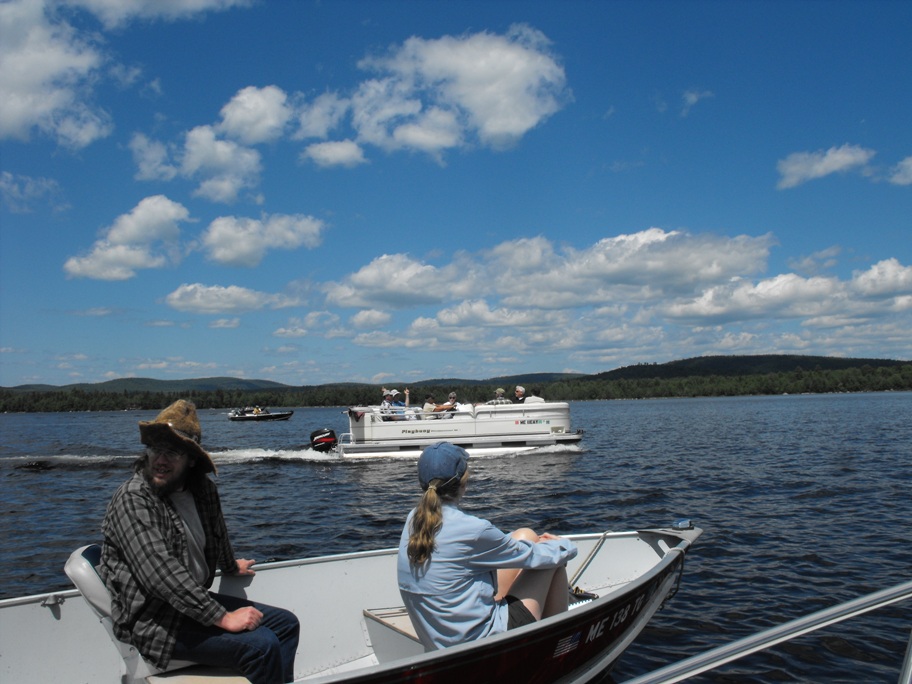
The LURC Commissioners were touring the Downeast Lakes in a pontoon boat on that same late June afternoon when I got my sunburn.  They explored the inlets and coves, viewed the islands and wooded shorelines.  When the flotilla’s motors were off, Commissioners heard the sweet sound of water lapping against the hull and the haunting call of nesting loons.  They felt the warm breeze lift their hair and the hot sun kiss their cheeks.  They watched the clouds scudding through the azure sky and viewed the jagged peaks of evergreens on the horizons. 

There is simply no way to mitigate that.

These are the words Governor LePage spoke in Rockport on June 18th  when referring to industrial wind projects:

"They are doing an awful lot of damage to our quality of life, our mountains… I don't think it's going to lower the cost of energy.  I think in 10 years we're going to be like Sweden and Denmark and we're going to be swearing at ourselves."

Let’s not wait ten years.  Let’s not suffer regret because we sat back and did nothing.  Let’s take a page from the playbook of the PPDLW and protect and preserve Maine now, before 300 miles of our mountains and thousands of acres forest and shorelines are sacrificed for massive, inefficient, unreliable and extremely expensive wind turbines.  Let’s forge ahead and work to encourage an energy policy based on science and economics.  In doing so, our Legislature will be convinced to repeal that damaging law which set this travesty in motion.  The Wind Energy Act was based on a presumption of benefits—many of which have been shown to be inaccurate or non-existent.  It’s time for facts to drive our policies and not vague assumptions that wind is a panacea for our energy concerns.

LURC Commissioners made a wise decision about a difficult issue.  Their job is not easy and I believe they agonize over their votes each time they must cast them.  I hope that they feel at peace with the verdict they arrived at for the Bowers project. 

I have no doubt that an hour spent on Pleasant or Junior or Scraggly Lake would remind them of exactly what tranquility is all about.

Monday, October 17, 2011

Voices on Bowers Mt. Wind project: Downeast Lakes Watershed

Maine Citizens Overwhelmingly Say “NO!” to First Wind’s Bowers Mountain Industrial Wind Proposal
In one of the most hotly disputed industrial wind development proposals to come before Maine’s Land Use Regulation Commission, citizens of this state spoke out in opposition to the Bowers project by a margin of 9:1.

Champlain Wind LLC, one of the many limited liability subsidiaries of First Wind of Boston, is proposing to build a grid-scale wind facility on Bowers Mountain in Carroll Plantation and Dill Hill in Kossuth Township.  The proposed development would site 22 wind turbines, each approaching 500 feet tall, on a ridge overlooking the Downeast Lakes Watershed.

Based on LURC’s Wild Land Lakes Assessment study of over 1,500 lakes, this watershed has the highest concentration of Class 1A and 1B rated lakes in the state. In order to achieve that rating a lake had to exhibit “outstanding values of statewide significance.”  There are at least six lakes in this watershed that have a “1A” rating, three that have a “1B” rating and numerous others that are rated as a “2”.

During the application process, Maine citizens requested and were granted a public hearing.  An astonishing 379 citizens gave oral or written testimony about this project.  Three hundred thirty-seven (345) or 91% of those testifying were opposed to First Wind’s Bowers Mountain project.

Due to concerns that such massive industrialization would seriously damage the area’s extraordinary scenic value; more than two dozen professional guides and many of the local sporting camp owners took precious time away from their businesses during peak tourist season to come to Lincoln to testify in person.  Three prominent organizations, representing nearly 1,000 Maine business owners who are familiar with the watershed, publicly came out against the Bowers project:

* The Maine Professional Guides Association, 900 strong, which has representatives on committees such as Tourism, Conservation, Land Access, Landowners Relations, River Trust and others, voted unanimously to oppose the Bowers project.
* The Maine Sporting Camp Association, which represents more than 50 sporting camp owners.
* The Grand Lake Stream Guides Association, representing 50 full-time professional guides who make their livelihood on the Downeast Lakes Watershed, voted unanimously to oppose the Bowers project.

Says Gary Campbell of the Partnership for the Preservation of the Downeast Lakes Watershed (PPDLW): "The siting of First Wind's proposed Bowers Wind project runs contrary to what makes Maine, Maine. This project would impact the    magnificent Downeast Lakes region, an area with a long history of    protection by both the legislature and locals. The region's economy is uniquely dependent on its ability to provide visitors with a remote, wilderness experience. Seeing 27 turbines, each the size of    a 42-story building, punctuate the horizon will make that impossible. This region's renowned culture of traditional Maine sporting camps and professional guides, would be lost forever."

And PPDLW's president, Kevin Gural, states:  "The Downeast Lakes watershed from West Grand Lake and Grand Lake Stream to the south, to Pleasant, Scraggly, and Shaw lakes at the north comprise one of Maine's few remaining easily accessible large watersheds that retains it's mostly undeveloped shoreline, wilderness character, and scenic splendor.  The opposition to the Bowers wind project has been steadfast, above board, and unprecedented in size and scope.  It includes a large group of property owners, and recreational users of this resource, but more importantly, it includes those who make their living and are the primary employers in the watershed.  The lodges, sporting camps, guides, and support businesses have all spoken passionately and often against this development application .  The Maine Sporting Camp Association, the Maine Professional Guides Association and the Grand Lake Stream Guides Association have all published posiiton statements against these poorly sited industrial wind projects.  Recreational tourism, whether it be fishing, hiking, canoe and kayak tripping, wildlife photography, or other outdoor pursuits, have been the lifeblood of this historic sportsmen's Mecca for well over a hundred years.  The very basic foundation of the area's businesses is at risk here. 

"In reviewing the testimonies of the 379 individuals and business men and women who testified on this application, 345 or 91% were adamantly AGAINST permitting this project.  We have faith that the LURC Commissioners will follow their mission statement and their CLUP (Comprehensive Land Use Plan) to vote unanimously to deny this development application.  In doing so, they will send a strong message to these wind project developers that Gov. Baldacci's Expedited Wind Permitting Law is meant to afford them a faster permitting process, but is not intended to circumvent LURC's or D.E.P.'s duties as stewards of our Maine's most valuable resource - it's "Quality of Place"."

Maine citizens have spoken up in opposition to the Bowers wind project.   It is our hope that the Maine Land Use Regulation Commission will deny First Wind/Champlain Wind's permit application on Wednesday, October 19, 2011.  Please come to the Waterfront Event Center, 8 Prince Street, Lincoln, Maine at 11:00 a.m. to show your support for the local residents, business owners and tourists who oppose the Bowers industrial wind development in the Downeast Lakes Watershed.